
- PPC helps plumbers buy timing. It can put your shop in front of urgent searchers while SEO is still building.
- The win is not cheap clicks. The win is tracked calls, booked jobs, and a cost per paying customer your margins can handle.
- Use PPC for emergencies, seasonal gaps, new service areas, and testing. Use plumbing SEO for the long-term base.
If the phones are quiet on a Tuesday morning, an SEO report does not help payroll today. That is where PPC earns its place. Paid search can put your plumbing company above the fold when somebody types "emergency plumber near me," "water heater repair," or "drain cleaning today."
But PPC can also burn money fast. A bad campaign is like sending a truck across town with no address, no dispatch notes, and no idea if the customer is home. The dashboard may look busy, but the phone tells the truth.
This guide breaks down 12 benefits of PPC advertising in 2026 for plumbers, with the owner-side math behind each one. It brings together current plumbing PPC benchmarks, owner-side campaign math, SearchLight's Q1 2026 plumbing Google Ads benchmark, Google Local Services Ads guidance, and WordStream's 2026 Google Ads benchmark report.
First, what PPC should do for a plumbing company
Pay-per-click advertising should help your company reach high-intent customers faster than organic channels can. That does not mean every click is good. It means the campaign should be built around service area, service type, call quality, landing page fit, and job value.
For a plumbing owner, PPC is worth considering when one of these problems is real:
- You need calls in a service area where you do not rank yet.
- You want more emergency, drain, sewer, repipe, or water heater opportunities.
- You need to test which services and suburbs can support more marketing spend.
- You want call data before committing months of SEO and content work.
- You need a backup while local SEO improvements compound.
The 12 PPC benefits plumbers should care about
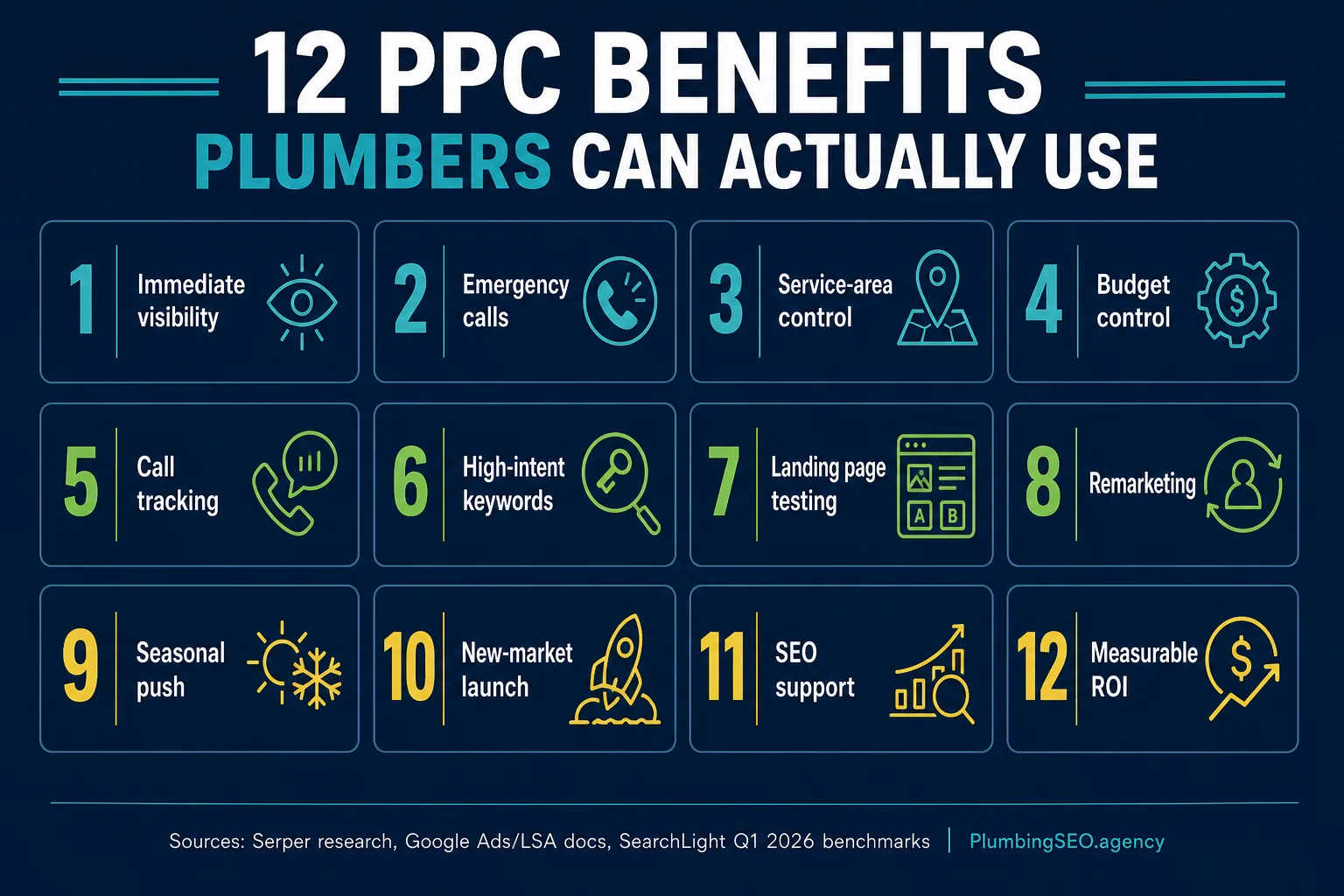
1. Immediate visibility for urgent searches
SEO takes time. PPC can put you in the paid results quickly once the campaign is approved, funded, and targeted correctly. That matters when a homeowner has water on the floor and is not reading a 2,000-word guide before calling.
2. Better control over service areas
Plumbing is local. You may want jobs in one city, avoid another zip code, or push calls near the shop to keep windshield time down. PPC lets you tighten geography instead of paying for interest from areas your trucks should not serve.
3. Service-specific campaigns
A plumbing company can separate drain cleaning, water heaters, sewer repair, leak detection, and emergency plumbing. That keeps ad copy, landing pages, and budgets tied to the work you actually want on the board.
4. Budget control when cash flow changes
Paid campaigns can be raised, lowered, paused, or shifted. That is useful during busy weeks, slow weeks, hiring changes, or a new truck rollout. PPC should not replace financial discipline, but it gives you a valve to turn.
5. High-intent keyword targeting
Search ads let you focus on people already looking for help. The difference between "how to unclog a drain" and "drain cleaning company near me" matters. One may be a DIY reader. The other may be ready to book.
6. Call tracking that shows what actually happened
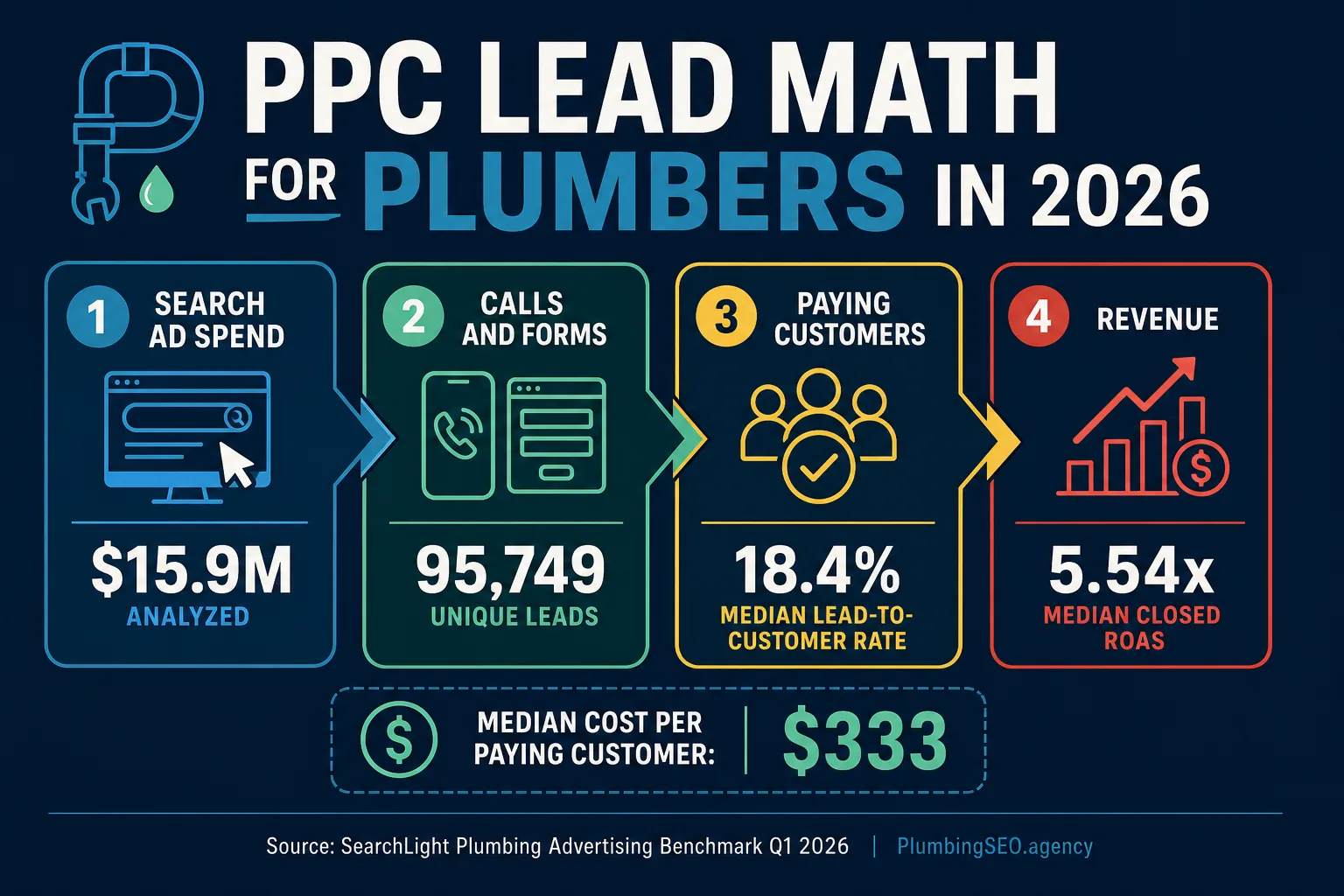
If PPC is not tied to call tracking, form tracking, booked jobs, and revenue, you are guessing. The 2026 benchmarks make that clear. SearchLight reported that the median plumbing contractor in its dataset converted 18.4% of Google Ads leads to paying customers, with a median cost per paying customer of $333 and 5.54x closed ROAS.
7. Faster landing page testing
PPC exposes weak landing pages quickly. If visitors call from a water heater page but bounce from an emergency plumbing page, you know where to fix copy, proof, service-area language, forms, and call buttons. That same learning can improve SEO pages too.
8. Seasonal and weather-driven pushes
Plumbing demand does not move in a neat spreadsheet. Cold snaps, storms, holidays, and local construction patterns can change the week fast. PPC gives you a way to push the right services when demand is likely to rise.
9. New service area testing
Before building a full local SEO campaign for a new suburb, PPC can test whether the area has demand, what calls cost, and whether your team can close the jobs. That is cheaper than guessing with six months of content and citations.
10. Local Services Ads can fit call-first plumbing work
Google says Local Services Ads help local customers find businesses and are paid for by leads rather than clicks. For plumbers, that model can fit urgent call-based work, but it still needs screening, dispute review, service-category control, and a clear plan for handling calls fast.
11. PPC can support SEO instead of fighting it
The smartest plumbing companies do not treat PPC and SEO like enemies. PPC can keep calls moving while SEO builds authority. SEO can lower long-term dependence on paid ads. If you want the deeper organic playbook, start with our plumber SEO homepage.
12. Measurable ROI when the account is built correctly
WordStream's 2026 benchmark report emphasizes that lead count alone misses the point. You need to know which leads became customers and feed that value back into bidding and reporting. For plumbers, that means every campaign conversation should include booked jobs, average ticket, close rate, and repeat customer value.
| Metric | Why it matters to a plumber | Owner question to ask |
|---|---|---|
| Cost per lead | Shows what calls and forms cost before quality is judged. | Are these real plumbing customers in our service area? |
| Cost per paying customer | Connects ad spend to booked jobs instead of noise. | Can our average ticket and margin support this? |
| Lead-to-customer rate | Shows whether dispatch, landing pages, and call handling are working. | Where are calls leaking before they become jobs? |
| Closed ROAS | Measures revenue from actual jobs, not just clicks. | Which services deserve more budget? |
When PPC helps most, and when to slow down
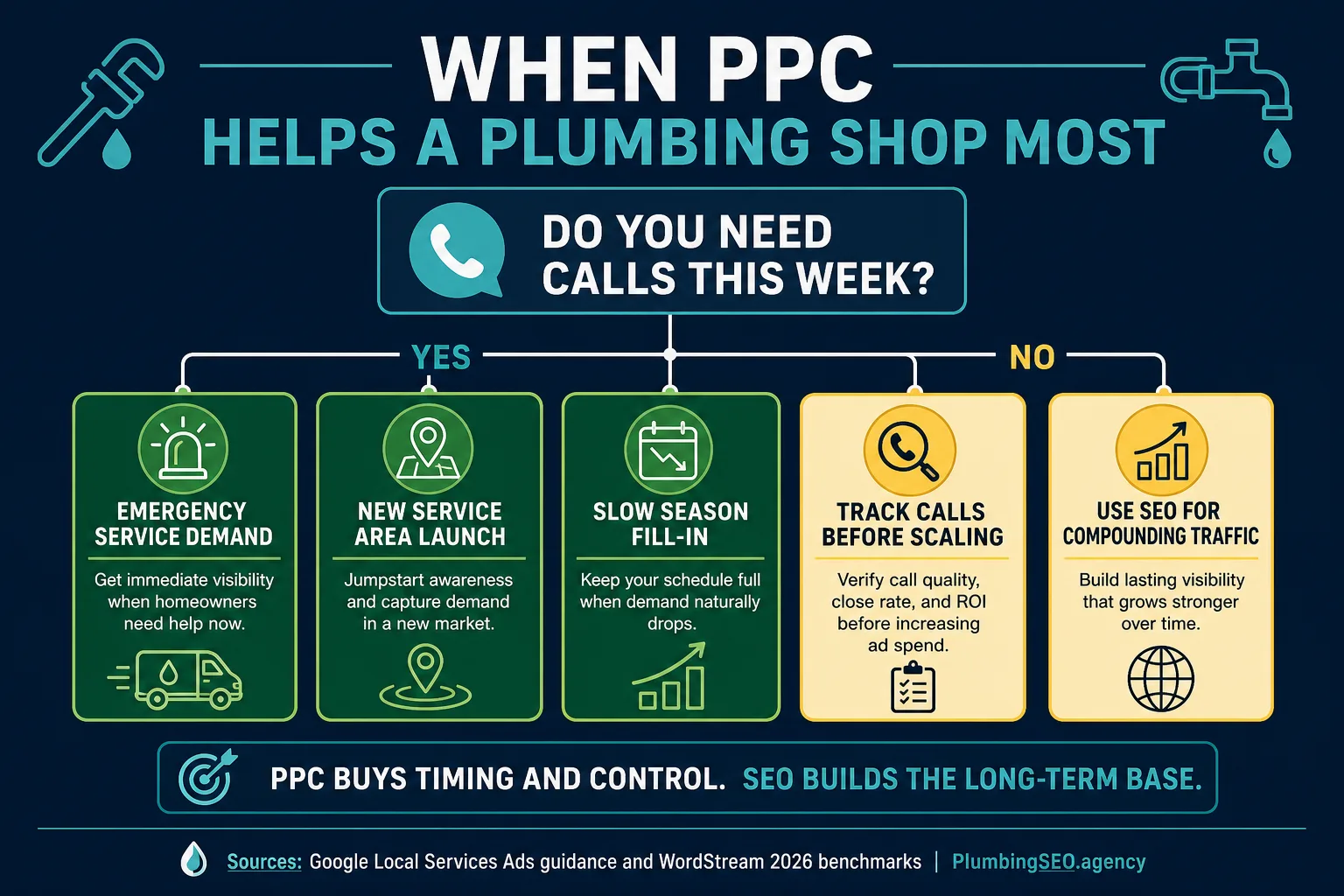
In my opinion, PPC is best when timing matters. If you need calls this week, want to test a new market, or have a crew with open capacity, paid search can be useful. If your website is weak, calls are not answered, tracking is missing, or the service area is too broad, fix that before scaling spend.
A simple implementation checklist
- Pick the services first. Do not run one vague campaign for every plumbing job under the sun.
- Set the service area tightly. Keep ads focused on places your trucks can serve profitably.
- Build matching landing pages. A drain cleaning ad should not land on a generic homepage.
- Use call tracking and form tracking. Track qualified calls, booked jobs, and revenue.
- Review search terms weekly. Cut DIY, job-seeker, wholesale, and irrelevant queries.
- Compare PPC with local SEO. Paid ads help now. SEO should keep reducing pressure over time.
Common PPC mistakes plumbing companies make
- Running ads without a real call-answering process.
- Targeting too wide a geography because the map looks nice.
- Sending all traffic to the homepage.
- Optimizing for cheap leads instead of booked plumbing jobs.
- Letting Performance Max or broad match spend freely without checking search intent.
- Ignoring SEO until paid costs feel painful.
If you want help deciding what should be fixed first, use the contact page and ask for a PPC plus SEO visibility review. We will look at service areas, tracking, landing pages, and the local SEO base before recommending more spend.
Frequently Asked Questions
PPC helps a plumbing business get visible for urgent searches, control which services and areas receive budget, and track calls back to campaigns. It is most useful when the company can answer calls quickly and measure booked jobs, not just clicks.
A plumber can run a small, tightly controlled campaign, especially for one service and one service area. Hire help if spend is large, tracking is missing, search terms are messy, or the landing pages need conversion work.
Paid ads can start producing impressions and calls soon after launch, but useful performance data usually takes a few weeks of search-term cleanup, call review, and landing page testing. Do not judge only by day-one clicks.
PPC is better for speed and control. SEO is better for compounding visibility and lower long-term dependence on ad spend. Most plumbing companies need both, but the split depends on cash flow, market competition, and how strong the website already is.
Track qualified calls, forms, booked jobs, average ticket, close rate, cost per paying customer, and closed revenue. Cost per click and cost per lead matter, but they do not prove the campaign is profitable.
Want PPC and SEO to work from the same job board?
We help plumbing companies connect paid ads, local SEO, service pages, call tracking, and reporting so the owner can see what turns into real work.
Get a Plumbing Marketing Review