
- A responsive website helps plumbing customers call from a phone without pinching, hunting, or giving up before dispatch ever hears from them.
- Google uses the mobile version of your content for indexing, so mobile layout, headings, schema, images, and service-area clarity all matter.
- The win is not a prettier website. The win is fewer lost calls, cleaner local SEO signals, easier updates, and a site that works when the customer is stressed.
Why responsive design matters for plumbing companies
A responsive website is not just a site that looks decent on a phone. For a plumbing company, it is the difference between a customer tapping your number or backing out and calling the next shop. Most urgent plumbing searches happen while somebody is standing next to a leak, a clogged toilet, a cold shower, or a floor that is getting wetter by the minute. They are not in the mood to zoom, scroll sideways, or solve your menu like a puzzle.
The practical definition is simple: one website, one URL, one set of content, and a layout that adapts to phones, tablets, laptops, and desktops. That matters for customers and it matters for search engines. Google Search Central explains mobile-first indexing as Google primarily using the mobile version of a page for indexing and ranking. In plain owner language, the mobile page cannot be the neglected version.
Here is the part generic responsive design articles miss: plumbers do not need a mobile site that wins design awards. They need a page that gets the right person to the right service, proves the company can be trusted, and makes the phone call easy. Pretty is fine. Booked jobs are better.
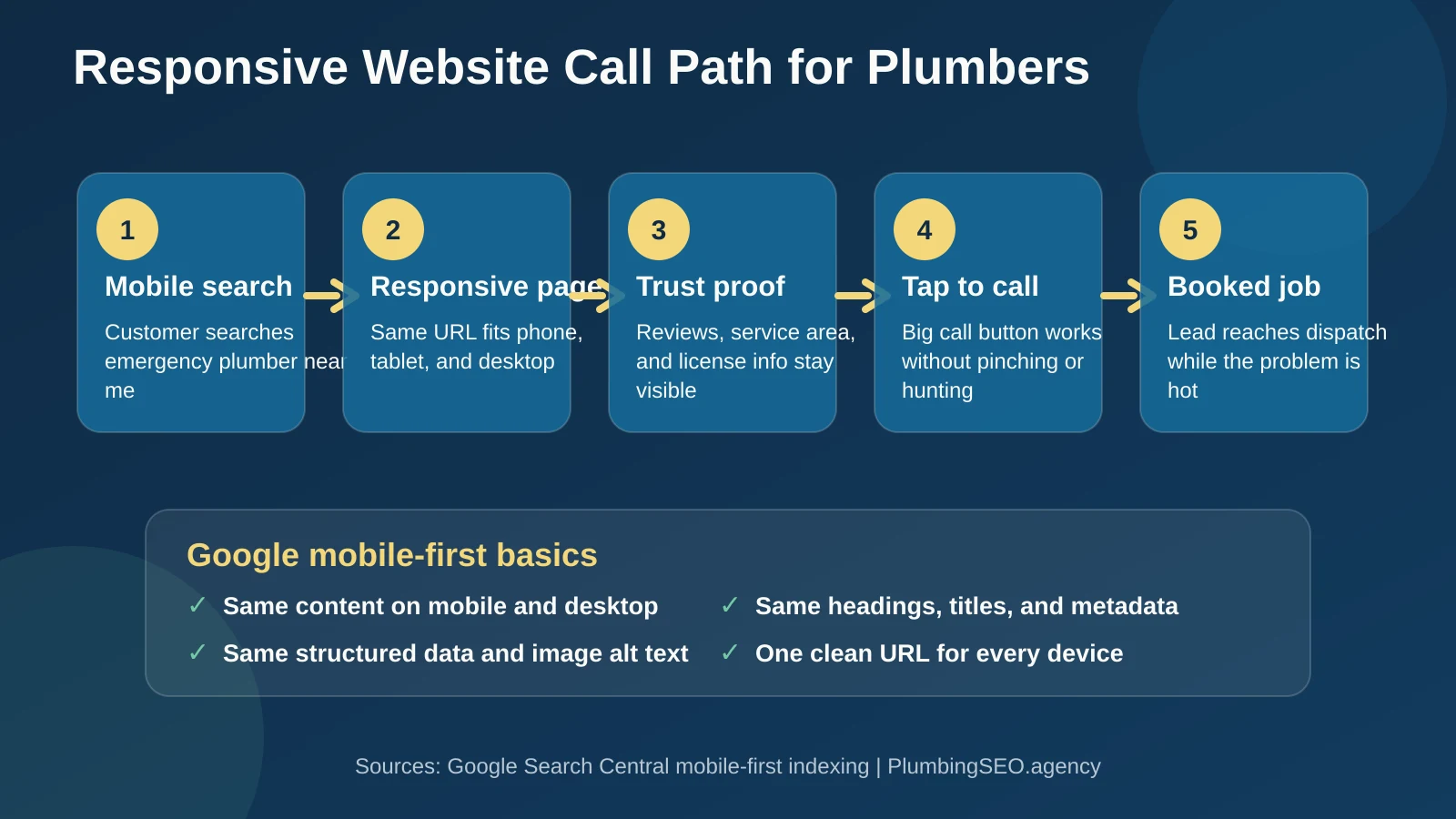
Responsive design works best when it shortens the path from mobile search to a booked job.
The 10 benefits of a responsive website for plumbers
Below are the benefits that actually matter to a plumbing owner. Each one connects back to calls, trust, local visibility, or easier day-to-day maintenance.
1. More mobile calls from ready-to-book customers
The biggest benefit is simple: customers can call you faster. A responsive plumbing site keeps the phone number, emergency service message, and main call button usable on small screens. That sounds basic until you check how many sites hide the number behind a tiny header, a slider, or a form that was built for desktop.
Speed matters too. Marketing Dive reported Google's finding that 53% of mobile visitors leave if a page takes longer than three seconds to load. A homeowner with water on the floor will not wait around because your hero image is having a big moment.
2. Better local SEO crawlability
Responsive design keeps your desktop and mobile visitors on the same clean URL. That is good for owners because there is one page to update. It is also good for SEO because the page's content, headings, links, structured data, and trust signals are not split across separate desktop and mobile URLs.
If you are working on SEO for a plumbing company, this makes audits cleaner. You can check one service page for drain cleaning, one water heater page, one city page, and one contact path instead of chasing separate mobile versions. Less mess means fewer leaks.
3. Lower bounce friction when people are stressed
A responsive layout removes the tiny frustrations that make visitors leave. Text stays readable. Buttons fit thumbs. Forms do not require sideways scrolling. Photos and reviews do not cover the call button. For emergency work, those little fixes matter because the customer is deciding quickly.
Think about your own phone habits. If a site makes you work too hard, you leave. Your customers do the same, and they may not come back after they find a competitor who made the next step obvious.
4. Tap-friendly navigation for service pages
Good plumbing website navigation should feel like a clean parts bin. Emergency plumbing, drain cleaning, water heaters, sewer line repair, leak detection, and service areas should be easy to reach without digging. A responsive menu stacks those choices for mobile users instead of cramming a desktop nav across a phone screen.
This helps customers and it helps your local SEO plan. When service pages are easy to reach, internal links are clearer, important pages get crawled, and customers can find the exact work they need.
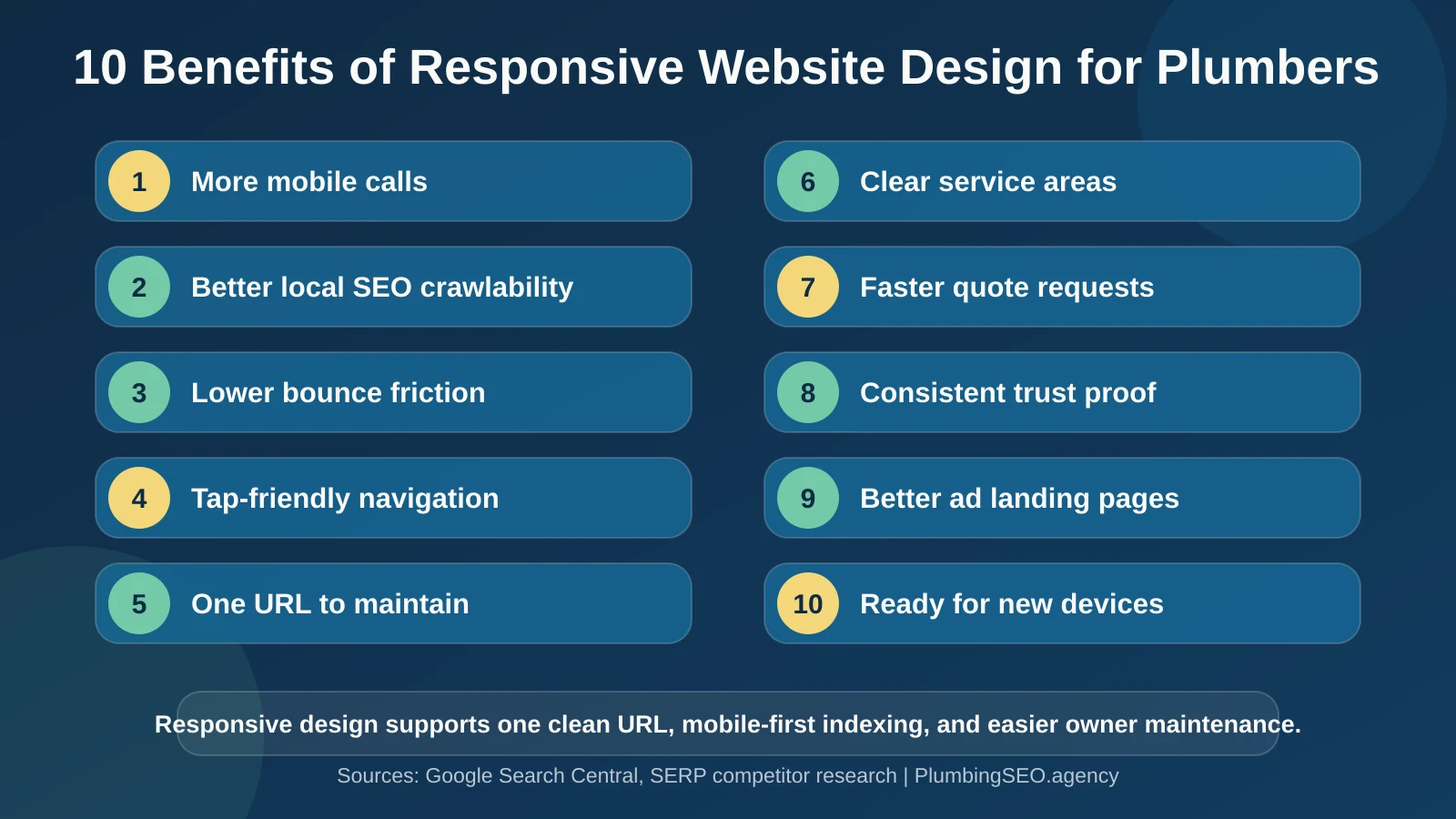
The best responsive sites turn technical design choices into customer actions: calls, quote requests, and clear trust signals.
5. One website to maintain instead of two headaches
Separate mobile sites create duplicate work. If your pricing note, service area, coupon, holiday hours, or financing message changes, somebody has to remember every version. Responsive design keeps the business running from one set of pages. That is easier for the owner, easier for the office, and easier for whoever updates the site.
This is not glamorous, but it saves mistakes. A plumbing company already has enough moving parts with trucks, crews, inventory, dispatch, reviews, and callbacks. The website should not add another hidden checklist.
6. Clearer service-area signals
Responsive design helps local intent show up cleanly on mobile. Your service areas, city pages, embedded map, nearby landmarks, and local proof can stay visible without forcing a customer to scroll through desktop clutter. If the homeowner cannot tell whether you serve their area, they may not call.
For deeper local search work, pair responsive design with a service-area strategy like the one in our advanced local SEO for plumbers guide. The site needs to tell Google and customers where you work, what you fix, and why you are a real local option.
7. Faster quote requests and form submissions
Not every plumbing lead is an emergency call. Repipes, remodel plumbing, water treatment, commercial work, and planned fixture installs often start with a form. Responsive design makes those forms easier to finish on mobile by using readable fields, correct keyboard types, short steps, and clear labels.
The rule is simple: ask for what dispatch needs, not every detail the office might want someday. Name, phone, address or city, service type, and a short message can be enough to start the conversation.
8. Consistent trust proof on every device
Customers want proof before they call. Reviews, licensing notes, insurance language, real crew photos, financing options, years in business, and guarantees need to show up cleanly on mobile too. A responsive site prevents the common problem where desktop looks trustworthy but mobile hides half the proof below clutter.
That trust proof matters most for bigger-ticket jobs. A customer choosing a water heater installer or sewer repair company is not only buying a fix. They are letting somebody into the home and trusting the work to hold.
9. Better landing pages for ads and local campaigns
If you run Google Ads, Local Services Ads, social posts, email, or truck QR codes, those clicks often land on mobile. A responsive landing page protects the money you already spent to get the visitor. The page should match the ad, load quickly, show the service, prove the area, and make the call button obvious.
This is where a lot of plumbing marketing budgets leak. The report says leads are expensive. The site quietly loses them. The phone tells the truth.
10. A site that is ready for new screens and habits
Responsive design is not just about today's iPhone size. It helps the site adapt as screen sizes, foldables, tablets, voice-assisted browsing, and in-app browsers keep changing. You still need maintenance, but you are not rebuilding the whole rig every time customers use a new device.
The practical owner takeaway: build the site around flexible content, fast loading, readable layouts, and clear actions. That kind of website ages better than a flashy desktop-only design.
What a plumber should check before calling the site responsive
Do not accept "mobile friendly" as a vague promise. Test the pages that make money. Open your homepage, emergency plumbing page, drain cleaning page, water heater page, top city page, and contact page on a real phone. Then ask whether a busy homeowner can figure out what you do, where you work, and how to reach you in under a few seconds.
| Checkpoint | Owner-side question | What to fix first |
|---|---|---|
| Call button | Can a customer tap to call without zooming? | Sticky call button, clear header phone, simple CTA text. |
| Service clarity | Can they tell you handle their exact problem? | Mobile service links, short headings, emergency language. |
| Local proof | Can they see you serve their area? | Service-area copy, city links, reviews, local photos. |
| Speed | Does the main content load before they get impatient? | Compress images, remove heavy scripts, improve hosting. |
| Form usability | Can they request help from a phone in one short pass? | Fewer fields, better labels, correct mobile keyboard inputs. |
Responsive design and Core Web Vitals
Responsive design is not only about fitting the screen. It should also feel fast and stable. Google-backed web.dev describes Core Web Vitals as quality signals for loading performance, interactivity, and visual stability. For plumbing sites, those metrics translate into a page that appears quickly, responds when the customer taps, and does not move the call button under their thumb.
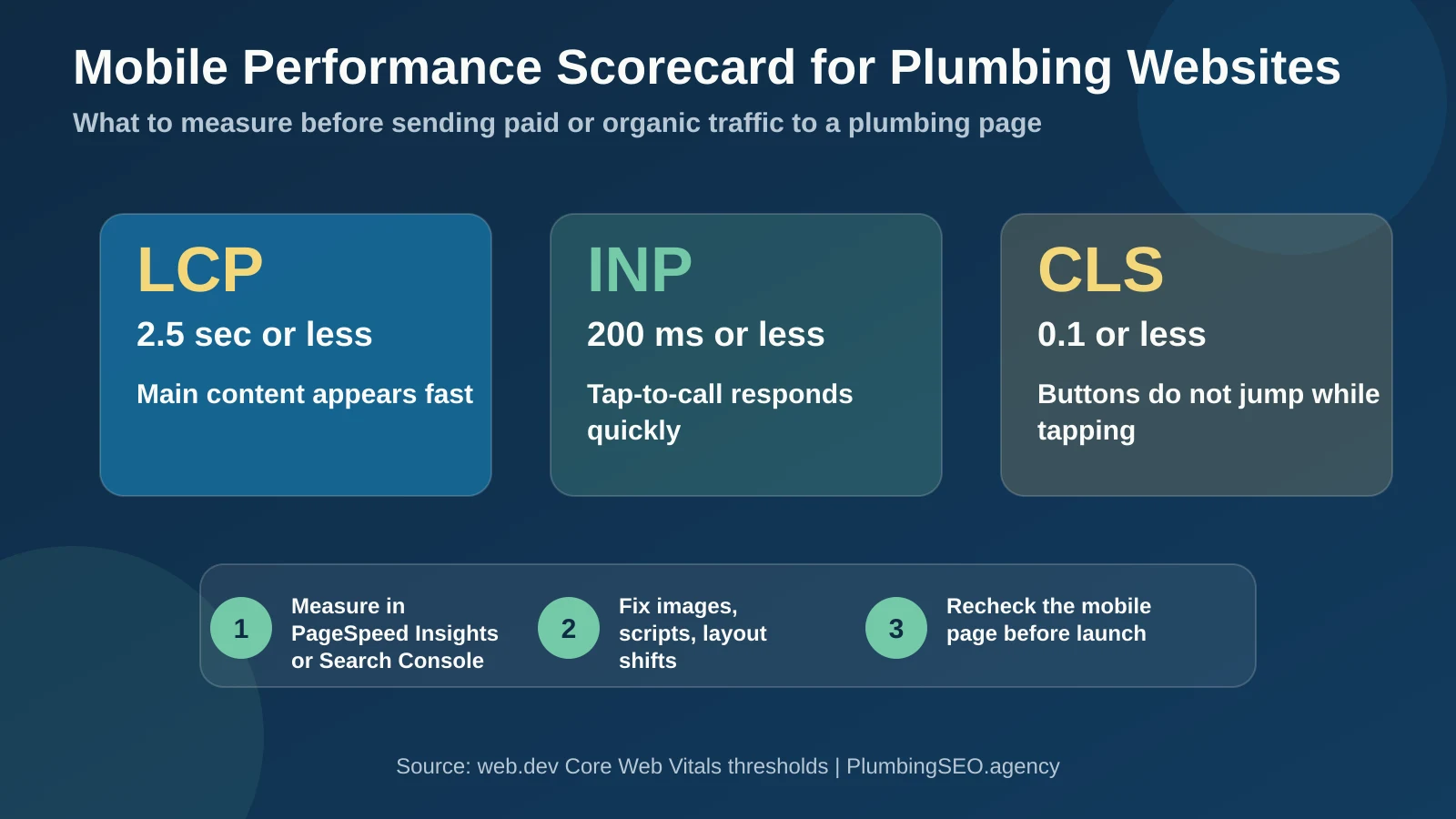
Use Core Web Vitals as a practical mobile quality check, not just a developer report.
For most plumbing owners, the exact metric names matter less than the behavior. Does the page show useful content quickly? Does the call button respond when tapped? Do images and banners stop jumping around? If the answer is no, the site may be costing you calls even if it looks modern on a desktop monitor.
Common responsive website mistakes plumbing companies make
Hiding the phone number behind design
A designer may want a clean header. A customer wants a phone number. If the number is hidden, tiny, or below the fold on mobile, fix that before anything else.
Using the same giant images everywhere
Big truck photos and team photos are useful, but they need to be compressed and sized correctly. A beautiful photo that slows the page can become an expensive roadblock.
Making forms too long
A homeowner with a plumbing issue should not have to fill out a tax return. Keep mobile forms short and let the office collect details after the first contact.
Forgetting the service-area question
Customers often wonder, "Do they come to my town?" Answer that clearly on mobile. If they have to hunt, they may call someone else.
Testing only the homepage
Most valuable traffic lands on service pages, city pages, and blog posts. Test those too. A responsive homepage does not save a broken water heater page.
Can plumbers do this themselves or should they hire help?
A small plumbing company can handle the basics in-house if somebody is comfortable with the website platform. Start by checking phone visibility, menu usability, service-area clarity, image size, form length, and PageSpeed Insights results. Those fixes can remove a lot of friction.
Hire help when the site needs deeper work: custom service pages, technical SEO cleanup, schema, speed repair, tracking, analytics, conversion testing, or a redesign tied to local SEO. A cheap theme can look fine and still leak calls. A good build connects design, search, tracking, and dispatch realities.
How long before results show up?
Some improvements show up immediately. If customers can finally tap the phone number and the page loads faster, calls can improve right away. SEO results take longer because Google has to crawl, process, and compare the updated pages against competitors.
Give technical changes a few weeks to be crawled and measured. Give local SEO and content improvements a few months to prove themselves. Watch the right numbers: calls from mobile, form submissions, booked jobs, service-area rankings, PageSpeed Insights, Search Console clicks, and conversion rate by page.
The next practical step
Open your website on your own phone and pretend you are a homeowner with water on the floor. Can you find the right service, trust the company, and call in under ten seconds? If not, start there. Do not let the website become the slow drain in your marketing.
If you want a second set of eyes, send us the site. We will look for the mobile leaks that stop plumbing customers from becoming booked jobs.
FAQs About Responsive Websites for Plumbers
A responsive website helps a plumbing business by making the site easier to use on phones, where many urgent searches happen. Customers can read the page, see service areas, trust the company, and tap to call without pinching or hunting.
Yes, plumbers can handle basic responsive fixes if the site platform is simple. Check phone buttons, image sizes, form length, menu usability, and mobile page speed. Hire help if the site needs technical SEO, schema, custom templates, tracking, or conversion repair.
Usability improvements can help immediately because customers can call or submit forms more easily. SEO impact usually takes weeks to months as Google recrawls the updated pages and compares them with other local competitors.
The most important responsive feature is an obvious mobile call path. The phone number, emergency service message, service area, and tap-to-call button should be easy to see and use on every major service page.
Responsive design supports local SEO by keeping content, links, headings, metadata, and structured data consistent on one URL across devices. It does not replace local SEO work, but it gives that work a cleaner technical foundation.
Want to know where your plumbing website is leaking calls?
We will check the mobile call path, page speed, local SEO basics, trust proof, and service-page structure so you know what to fix first.
Request a Website Leak Check