
- Local search is daily buying behavior, not background traffic: multiple sources show frequent local searches, smartphone usage, and fast offline purchases.
- Reviews are now a conversion threshold: recent, high-quality reviews and owner responses can decide whether a small business gets the call.
- For plumbers, SEO budget should fix visibility, trust, mobile calls, service-area proof, and tracking together instead of chasing rankings alone.
If you own a plumbing company or another local service business, SEO is not an abstract traffic channel. It is how homeowners find you when a drain backs up, a water heater fails, or a competitor looks more trustworthy in Google Maps. These small business SEO statistics show where search demand, reviews, mobile behavior, and local conversion are moving in 2026.
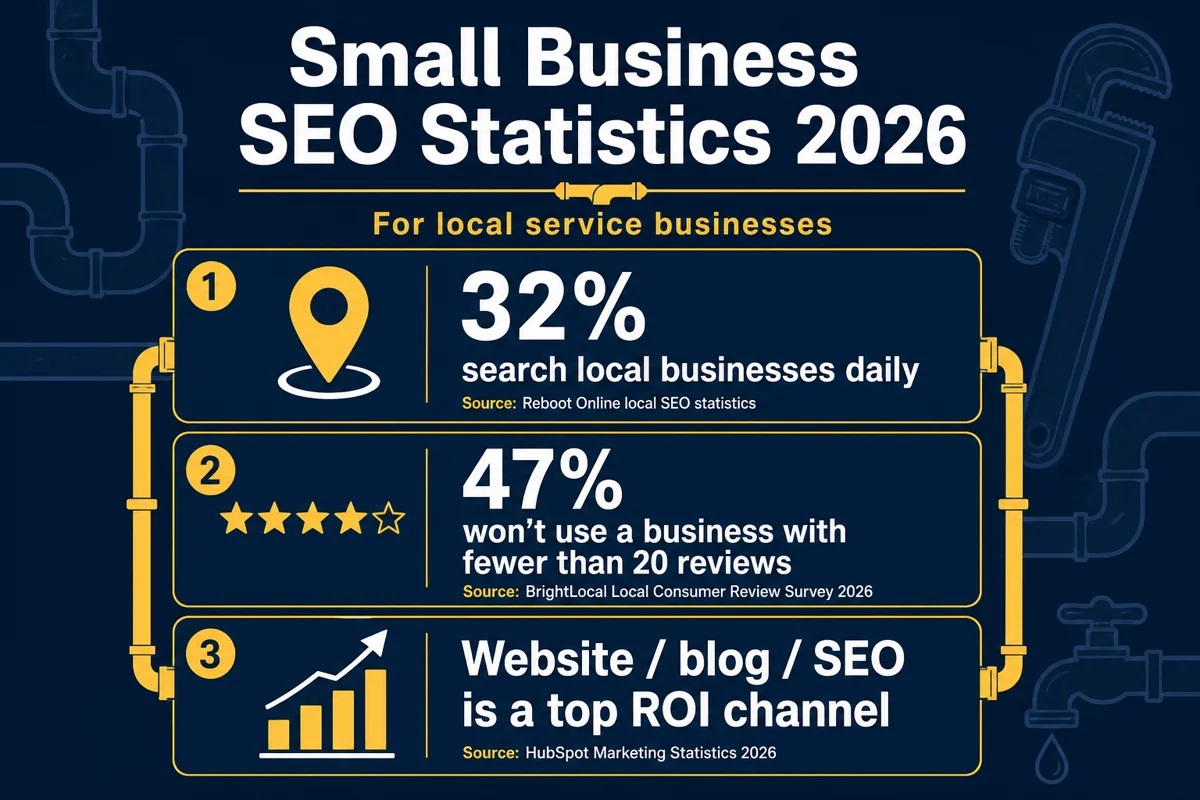
- Local intent is huge: LocaliQ reports that 46% of Google searches are local, while Reboot Local SEO reports that 32% of consumers search for local businesses daily.
- Reviews are now a hard conversion gate: BrightLocal found that 47% of consumers will not use a business with fewer than 20 reviews, and 74% focus on reviews written in the last three months.
- Mobile still decides many local outcomes: LocaliQ reports that 58% of people search for a local business on a smartphone daily and 78% of local mobile searches result in an offline purchase.
- For plumbing companies, the practical SEO priorities are clear: accurate Google Business Profile data, recent reviews, fast mobile calls, service-area proof, helpful service pages, and call tracking.
Table of contents
- Headline small business SEO statistics
- Local search and Google Business Profile data
- Review and reputation statistics
- Mobile, calls, and conversion statistics
- Budget, ROI, and execution benchmarks
- 75+ data points table
- Methodology and source notes
1. Headline small business SEO statistics
The big picture is simple: local search is frequent, review expectations are rising, and Google is often the new front door for a local business. For a plumbing company, that means SEO should not be separated from dispatch, reputation, phone-answering, and service-area strategy.
WordStream reports that organic traffic accounts for 53% of all trackable website traffic and that 61% of small businesses were not investing in SEO, while 71% of small businesses that were investing in SEO were satisfied with their results. That gap creates an opening for companies that execute consistently instead of treating SEO as a one-time setup.
2. Local search and Google Business Profile data
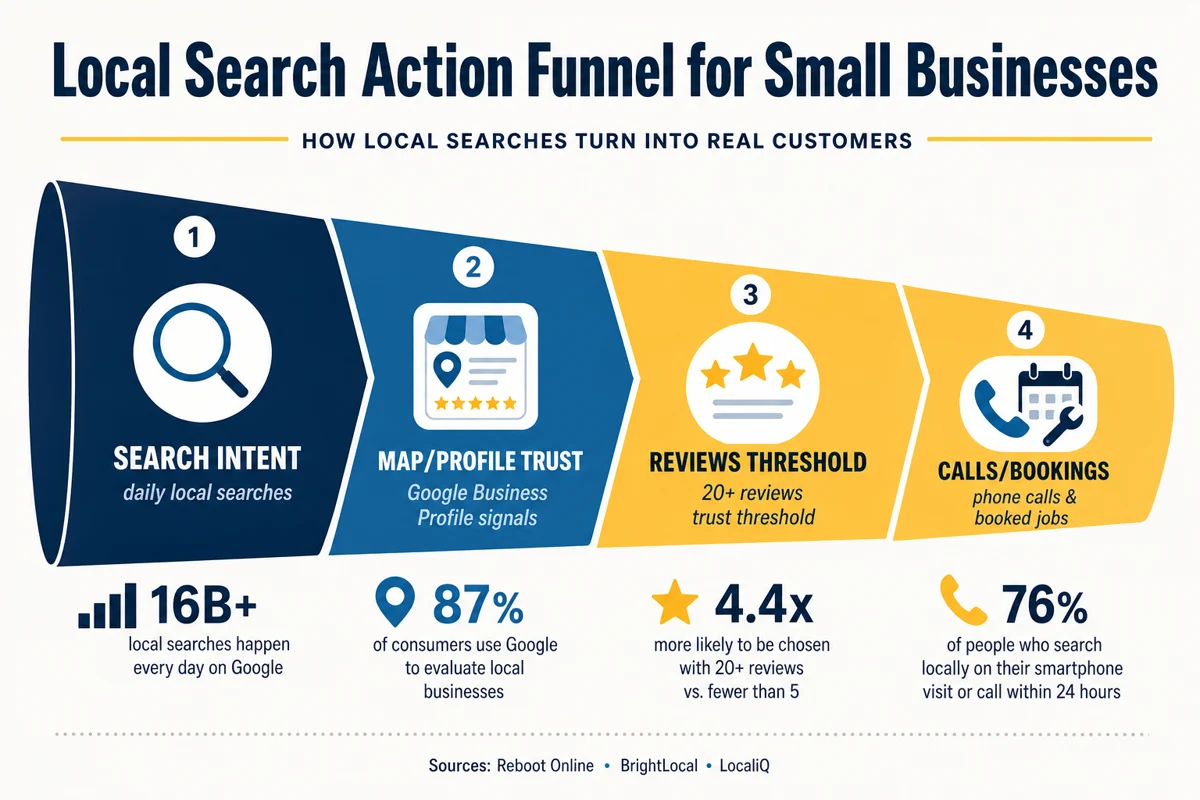
Local SEO is the branch of SEO that matters most to service companies. LocaliQ reports that 46% of Google searches are local, and Salesgenie reports that 45% of consumers default to Google for location-specific searches while 15% use Google Maps as their first choice. For plumbers, that makes Google Business Profile optimization, accurate service areas, photos, reviews, and map visibility central to call volume.
3. Review and reputation statistics
Reviews are not just a ranking discussion. They decide whether a searcher trusts the business enough to click, call, or keep comparing. BrightLocal found that 97% of consumers read reviews for local businesses and that 47% will not use a business with fewer than 20 reviews. The same survey found that 74% care about reviews written in the last three months.
That is why a plumbing SEO plan should include review request timing, owner replies, job-type keywords in natural customer language, and a response process for complaints. A company can rank and still lose if the nearby competitor looks more recent, more responsive, and safer to hire.
4. Mobile, calls, and conversion statistics
Mobile behavior turns SEO from a visibility project into a revenue project. LocaliQ reports that 58% of people search for a local business on a smartphone daily, 78% of local mobile searches result in an offline purchase, and 24% of Google Business Profile actions are calls. If a plumber's page loads slowly, hides the phone number, or sends visitors to a weak form, rankings leak jobs.
For plumbing companies, the mobile checklist is practical: sticky phone access, clear emergency service language, visible service areas, trustworthy reviews, fast pages, and call tracking that separates organic, map, and paid demand.
5. Budget, ROI, and execution benchmarks
SEO budgets work best when technical health, local proof, and content depth reinforce each other. Reboot SEO reports that businesses allocate 10-20% of digital marketing budgets to SEO and that the SEO services market is estimated at $83.9 billion in 2026. WordStream reports that businesses spend an average of $500 to $7,500 per month on SEO.
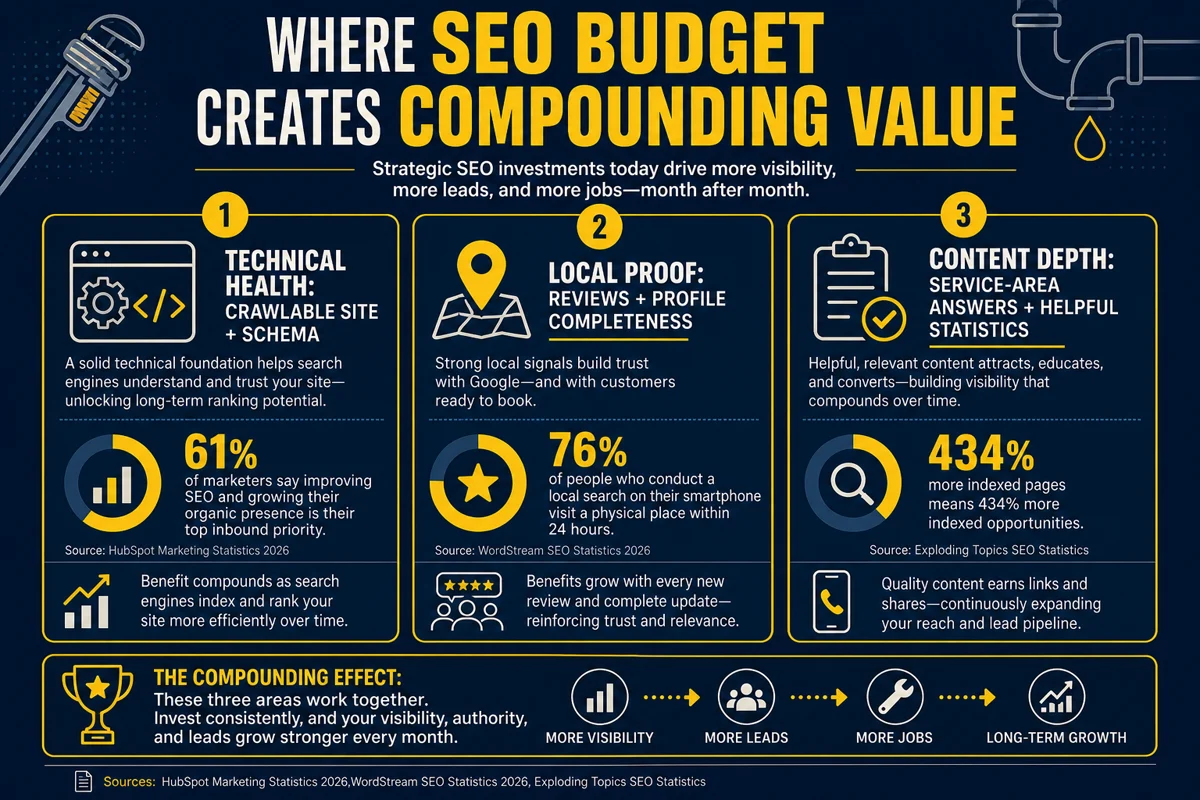
For a plumbing company, that means budget should not disappear into vague reports. It should produce measurable improvements: fixed listing data, stronger service pages, more recent reviews, clearer calls-to-action, better call tracking, and local content that helps homeowners choose faster. If you need a plumbing-specific strategy, see our SEO for plumbers guide and our related plumbing SEO statistics and local SEO for plumbers statistics posts.
6. 75+ small business SEO data points for 2026
The table below aggregates the most useful numbers for small business owners and translates each one into an action. The point is not to memorize every percentage. The point is to decide which leak is costing calls: visibility, trust, mobile conversion, or measurement.
| # | Category | Statistic | Source | What it means for a local business |
|---|---|---|---|---|
| 1 | Local search frequency | 32% of consumers complete online searches for local businesses daily | Reboot Local SEO | Use fresh service-area pages, Google Business Profile updates, and current hours because local search is a daily habit. |
| 2 | Review checking | 42% of consumers regularly check online reviews when researching a local business | Reboot Local SEO | Treat review generation and replies as part of operations, not a once-a-quarter marketing chore. |
| 3 | Google as review source | 81% of consumers used Google to research local businesses in 2024 | Reboot Local SEO | Your Google Business Profile is often the first trust screen before a customer reaches your website. |
| 4 | Minimum star expectations | 37% of consumers expect at least four stars before considering a local business | Reboot Local SEO | A weak average rating can suppress calls even when rankings look good. |
| 5 | Parent-brand effect | 26% of consumers say reviews of a local outlet affect their opinion of the larger parent brand | Reboot Local SEO | Multi-location companies need location-level review hygiene, not only brand-level reputation. |
| 6 | Local marketer service mix | Video marketing grew 11% as a service offered by local marketers between 2022 and 2023 | Reboot Local SEO | Short proof videos and job-site visuals can support local trust alongside written SEO content. |
| 7 | AI in local SEO teams | 20 of 44 local SEO experts interviewed use generative AI for content creation | Reboot Local SEO | Use AI to speed drafting and QA, but keep facts, service claims, and local proof verified by people. |
| 8 | Local marketer salary | The average salary of local marketers in the USA was reported at $109,575 in 2023 | Reboot Local SEO | Good local SEO talent is expensive; owners should expect real strategy work to cost more than a listing scan. |
| 9 | Daily local web search | 21% of internet users search for local businesses every day | Reboot Local SEO | Missing local visibility means missing daily demand, not occasional research traffic. |
| 10 | Weekly local search | 24% of users search online for local businesses at least once per week | Reboot Local SEO | Even slower seasons still produce recurring local search opportunities. |
| 11 | Multiple weekly searches | 32% of users search for local businesses multiple times per week | Reboot Local SEO | Keep service pages and location proof updated because prospects compare multiple options. |
| 12 | Restaurant mobile split | 57.22% of users on restaurant local business sites were mobile users | Reboot Local SEO | Mobile conversion patterns vary by category, but service businesses still need fast mobile calls. |
| 13 | Restaurant desktop split | 42.78% of users on restaurant local business sites were desktop users | Reboot Local SEO | Do not ignore desktop quote-form and dispatch-page usability. |
| 14 | Estate agent mobile split | 51.29% of users on estate-agent local business sites were mobile users | Reboot Local SEO | Local research often begins on mobile even for high-consideration purchases. |
| 15 | Near-me trend | The Google Trends index for “near me” ranged from 57 to 64 in 2024 versus five to six a decade earlier | Reboot Local SEO | Near-me intent has become mainstream; service-area proof has to be specific. |
| 16 | Review always-read trend | 34% of consumers always read local business reviews in 2022 | Reboot Local SEO | Review habits were already strong before the latest trust jump. |
| 17 | Review always-read current | 33% of consumers always read local business reviews in 2024 | Reboot Local SEO | Review reading remained sticky instead of fading. |
| 18 | Review regular-reading trend | 43% of consumers regularly read online reviews in 2022 | Reboot Local SEO | A large middle group checks reviews when the job matters. |
| 19 | Review regular-reading current | 42% of consumers regularly read online reviews in 2024 | Reboot Local SEO | Review management is a stable conversion lever. |
| 20 | Google reviews 2023 | 87% of consumers used Google to research local businesses in 2023 | Reboot Local SEO | A drop or inconsistency in Google review quality is highly visible. |
| 21 | Reviews in decisions | 97% of consumers read reviews for local businesses | BrightLocal | Assume nearly every buyer sees your review profile before calling. |
| 22 | Always read reviews | 41% of consumers always read reviews when browsing for businesses in 2026 | BrightLocal | For emergency services, reviews can decide the shortlist before price is discussed. |
| 23 | Review-site breadth | Consumers used an average of six review sites in 2026 | BrightLocal | Google matters most, but Apple Maps, Facebook, BBB, and vertical directories still need clean information. |
| 24 | Google review share | Google’s share as a review source was 71% in 2026 | BrightLocal | Google remains the core profile, even as other sources and AI recommendations grow. |
| 25 | AI recommendations | Use of ChatGPT and other generative AI tools for local recommendations rose to 45% | BrightLocal | Clear business facts, reviews, and authoritative pages help answer engines understand your company. |
| 26 | Apple Maps usage | Apple Maps usage nearly doubled from 14% in 2025 to 27% in 2026 | BrightLocal | Apple Maps cleanup is no longer optional for mobile-heavy local businesses. |
| 27 | Local news reviews | Local news sites fell to 29% as a local business recommendation source | BrightLocal | Local press is useful, but profile and review ecosystems carry more daily decision weight. |
| 28 | Review-count threshold | 47% of consumers will not use a business with fewer than 20 reviews | BrightLocal | A company with five great reviews still looks thin next to a competitor with steady volume. |
| 29 | Review recency | 74% of consumers only care about reviews written in the last three months | BrightLocal | Ask after every completed job so the profile never looks stale. |
| 30 | High-star threshold | 31% of consumers will only use a business with 4.5 stars or more | BrightLocal | One-star complaints need fast, professional responses and operational fixes. |
| 31 | Positive review content | 46% of consumers prioritize whether the review describes a positive experience | BrightLocal | Specific customer language about speed, cleanliness, and professionalism converts better than generic praise. |
| 32 | Recent-posted reviews | 44% of consumers prioritize whether a review was posted in the last month | BrightLocal | Freshness can matter as much as total count. |
| 33 | Star factor | 42% of consumers prioritize high star rating as a review factor | BrightLocal | Star quality and review volume have to move together. |
| 34 | Very low review tolerance | Only 9% of consumers are willing to use a business with five or fewer reviews | BrightLocal | New locations need an early review ramp plan before aggressive SEO spend. |
| 35 | Last-week recency | 18% of consumers are only swayed by reviews written within the last week | BrightLocal | Recent jobs should feed the reputation flywheel. |
| 36 | Two-week recency | 32% of consumers look for reviews written in the last two weeks | BrightLocal | A monthly review burst is weaker than a steady weekly cadence. |
| 37 | Star ratings matter | 92% of consumers care about star ratings when choosing a business | BrightLocal | Ratings are a conversion metric, not vanity data. |
| 38 | Perfect-rating requirement | 10% of consumers will only use a business with a five-star rating | BrightLocal | Perfect ratings help, but most buyers also judge volume, recency, and response quality. |
| 39 | Positive reviews lift usage | 85% of people are more likely to use a business after reading positive reviews | BrightLocal | Good reviews can turn ranking visibility into booked calls. |
| 40 | Negative reviews deter | Negative reviews deter 77% of consumers | BrightLocal | Unanswered complaints leak revenue even if the company ranks. |
| 41 | Website check after reviews | 54% of consumers check the business website after reading positive reviews | BrightLocal | Your website must reinforce the trust your reviews created. |
| 42 | Research after reviews | 66% of consumers do more research after reading a positive review | BrightLocal | Review wins should point buyers to helpful service pages, photos, and proof. |
| 43 | Booking after reviews | 34% of consumers make a purchase or booking after reading a positive review | BrightLocal | Strong reviews can shorten the route from search to call. |
| 44 | Purchase after reviews | 93% of consumers have made a purchase after reading reviews | BrightLocal | Reviews influence real spending, not only sentiment. |
| 45 | High-ticket review influence | 27% of consumers spent over $1,000 after reading reviews | BrightLocal | For plumbing, sewer, repipe, and water heater work, review trust can affect high-value jobs. |
| 46 | Review regret | 70% of consumers have made a purchase they later regretted after reading reviews | BrightLocal | Trust is fragile; do not game reviews or overpromise in responses. |
| 47 | High-ticket regret | 14% of consumers regretted spending over $1,000 after reading reviews | BrightLocal | Accurate service claims and transparent expectations protect long-term reputation. |
| 48 | Review trust | 49% of consumers trust reviews as much as personal recommendations | BrightLocal | Online reputation now competes with word-of-mouth. |
| 49 | Local Google queries | 46% of Google searches are local | LocaliQ | Local pages and profile optimization can reach buyers with immediate intent. |
| 50 | Google search volume | Google processes about 8.5 billion searches per day | LocaliQ | Even niche local categories sit inside a huge daily demand channel. |
| 51 | Queries per second | Google processes about 99,000 searches per second | LocaliQ | Local SEO is a constant market, not a campaign window. |
| 52 | Mobile local conversion | 80% of local mobile searches convert | LocaliQ | Click-to-call, fast pages, and clear service areas matter. |
| 53 | Online local learning | 97% of people learn more about a local company online than anywhere else | LocaliQ | The web is the default due-diligence layer. |
| 54 | Reviews and ranking perception | 90% of brands found online reviews impacted local rankings | LocaliQ | Review strategy supports both trust and visibility. |
| 55 | Local SEO importance | 35% of businesses feel local SEO is important | LocaliQ | Many competitors still under-prioritize local SEO, leaving room for focused operators. |
| 56 | Traffic and lead challenge | 61% of businesses say generating traffic and leads is their number one challenge | LocaliQ | SEO should be measured by qualified calls and jobs, not only rankings. |
| 57 | Incorrect listings | 50% of business owners have seen incorrect information on local listings | LocaliQ | NAP, hours, and phone cleanup can prevent obvious lost calls. |
| 58 | Lead close rate | Local SEO leads have nearly a 15% close rate | LocaliQ | Organic local leads often arrive with stronger intent than cold outreach. |
| 59 | Fast local purchases | 28% of local searches result in a purchase within 24 hours | LocaliQ | Emergency and repair businesses need same-day conversion paths. |
| 60 | Small-business local SEO presence | 64% of small businesses have a local SEO presence | LocaliQ | The baseline is rising; weak profiles fall behind. |
| 61 | High-ROI campaigns | 40% of local SEO campaigns achieve a 500% or better ROI | LocaliQ | Compounding SEO can beat one-off ad spend when tracked properly. |
| 62 | Reputation premium | People are willing to pay 22% more for a local product or service with a good online reputation | LocaliQ | Reputation can protect margins as well as lead volume. |
| 63 | Local traffic share | For the average business, nearly 25% of website traffic comes from local searches | LocaliQ | Local intent deserves its own landing pages and tracking. |
| 64 | Top-result age | The average page in the top 10 local search results is over two years old | LocaliQ | Durable pages can keep earning if updated and linked. |
| 65 | Best ROI channel | 49% of businesses say local organic search brings their best marketing ROI | LocaliQ | Local SEO should be compared against PPC and pay-per-lead on booked jobs. |
| 66 | Smartphone local search | 58% of people search for a local business on their smartphone daily | LocaliQ | Mobile speed and tap-to-call UX are revenue issues. |
| 67 | Offline purchase after mobile | 78% of local mobile searches result in an offline purchase | LocaliQ | Local SEO impacts real-world service calls and store visits. |
| 68 | GBP website actions | 56% of Google Business Profile actions are website visits | LocaliQ | The website has to answer the next question after the profile click. |
| 69 | GBP call actions | 24% of Google Business Profile actions are calls | LocaliQ | Phone tracking and answer-rate reporting belong in local SEO dashboards. |
| 70 | GBP direct searches | 20% of Google Business Profile actions lead to other direct searches | LocaliQ | Profiles can create brand demand even before a form fill. |
| 71 | Question-style local queries | About 8% of local search queries are phrased as questions | LocaliQ | FAQ sections and helpful service pages can capture problem-based searches. |
| 72 | One-week purchases | 90% of consumers who search for a local business make a purchase within one week | LocaliQ | Local search follow-up windows are short; slow responses lose jobs. |
| 73 | Smartphone before store | One in three people use a smartphone to search for products before visiting a physical store nearby | LocaliQ | Mobile comparison behavior also applies to nearby service choices. |
| 74 | Google as homepage | 42% of businesses agree Google is becoming the new homepage for local businesses | LocaliQ | Profiles, posts, photos, and reviews are front-door assets. |
| 75 | Automated listing management | Over 40% of businesses have adopted automated local listing management | LocaliQ | Automation helps, but service details and review replies still need human judgment. |
| 76 | SEO tool stack | Over two-thirds of businesses use two to five SEO tools for local SEO work | LocaliQ | Tools are common; execution quality is the difference. |
| 77 | Heavy tool users | 12% of businesses use six or more SEO tools | LocaliQ | More dashboards do not guarantee more calls. |
| 78 | Outsourced local SEO | 40% of SMBs outsource local SEO work | LocaliQ | Owners often need outside help for tracking, content, and profile consistency. |
| 79 | Local SEO industry value | The local SEO industry is worth over $80 billion | LocaliQ | The category is mature enough to demand accountability from vendors. |
| 80 | Online absence penalty | 62% of consumers disregard a business if they cannot find it online | LocaliQ | If the company is invisible online, many buyers never call. |
7. Methodology and source notes
This roundup uses current public SEO, local search, and review research from established marketing publishers and local search research providers. Priority went to sources that publish clear numbers, source context, and practical relevance for small businesses. Statistics were grouped by local search demand, reputation, Google Business Profile behavior, mobile conversion, budget, and execution implications.
Because this site serves plumbing companies, each statistic is interpreted through a local service lens: Will this help an owner get found, earn trust, get calls, or stop wasting budget? Broad small business data is included when it helps explain the market, but the action notes are written for plumbers, HVAC companies, electricians, roofers, and other appointment-based local operators.
Frequently Asked Questions
The most important numbers are the ones tied to local intent, trust, and conversion: daily local search frequency, review count and recency expectations, Google Business Profile actions, mobile behavior, and the share of businesses reporting strong local organic ROI.
Use the data to prioritize fixes. For a plumbing company, that usually means cleaning up Google Business Profile data, building fresh reviews, improving mobile click-to-call paths, publishing useful service pages, and tracking calls by source.
Prefer primary surveys, transparent benchmark studies, and well-known marketing research publishers. This roundup cites sources such as BrightLocal, LocaliQ, Reboot Online, WordStream, Salesgenie, Exploding Topics, and HubSpot, then translates the numbers into local-service decisions.
Yes. Search engines, maps, review platforms, and AI recommendation tools all depend on clear business data, reputation signals, helpful pages, and authority. SEO is becoming broader, but it is not optional for companies that want to be found and trusted.
There is no universal number, but BrightLocal found that 47% of consumers will not use a business with fewer than 20 reviews. For most local service companies, a healthy review count, recent reviews, strong ratings, and owner responses are all needed to turn rankings into calls.
Want to Turn These SEO Statistics Into More Plumbing Calls?
We will review your Google Business Profile, service pages, review profile, tracking, and local competitors, then show where your calls are leaking.
Book a Plumbing SEO Review