
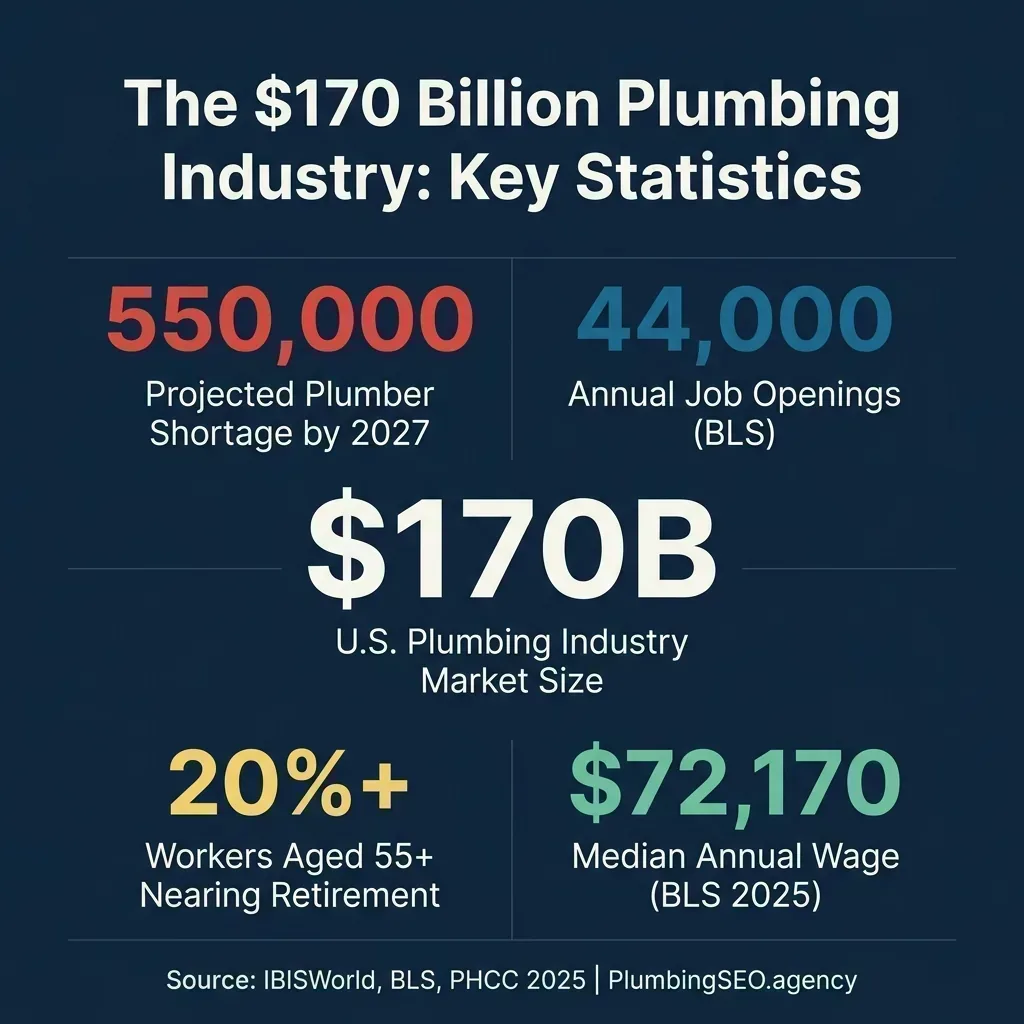
- The U.S. plumbing industry is worth $170+ billion with a projected shortage of 550,000 workers by 2027. Plumber income ranges from $33K as an apprentice to $250K+ as a business owner - and the ceiling keeps rising.
- Dustin Deise quit school in 9th grade, started at $8/hour as a laborer, and built himself into one of the top service plumbers in Dallas - then opened his own company, Tas Plumbing, with his wife.
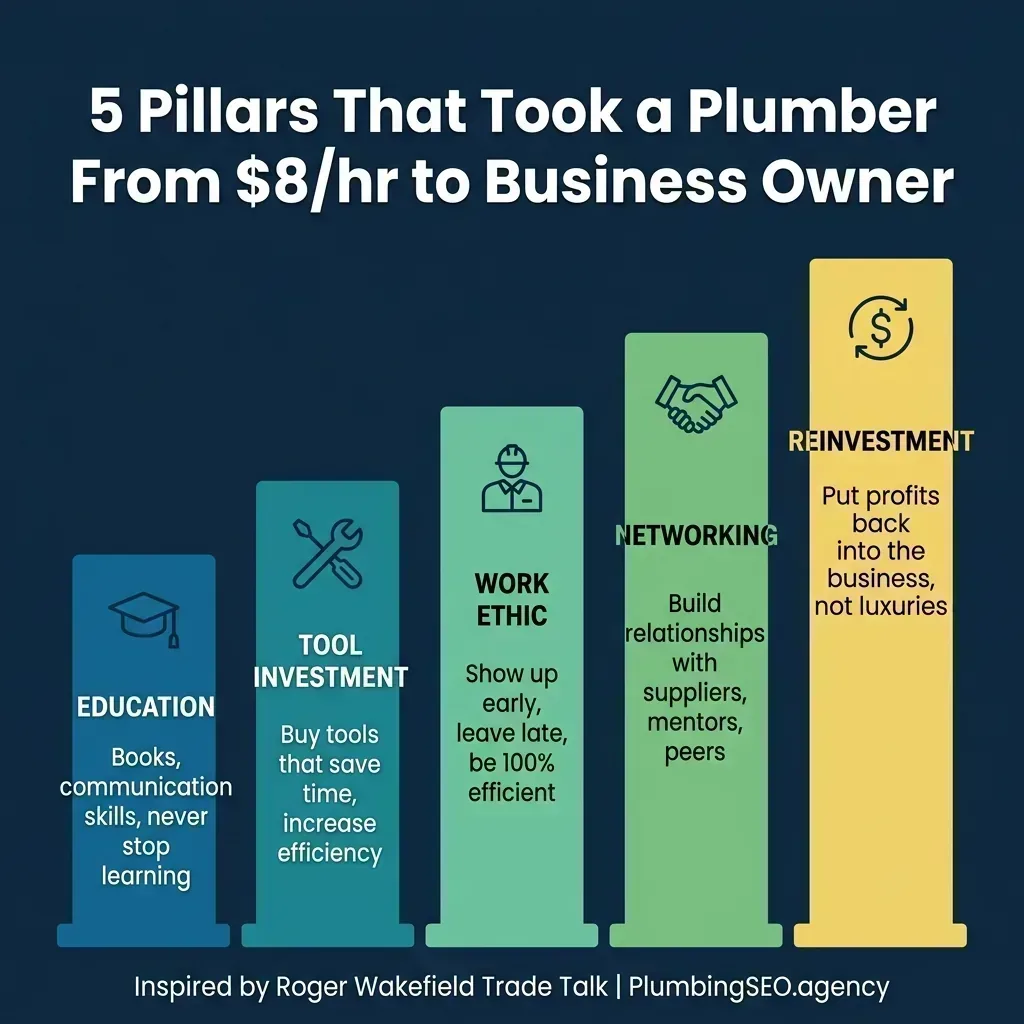
- The five things that separated Dustin from every other plumber: education, tool investment, work ethic, networking, and reinvesting everything back into the business instead of buying luxuries.
The $170 Billion Industry That Nobody Talks About
There is a career path in America where you can start with zero college debt, earn six figures within a decade, and build a company worth seven figures - all while society tells you that you are "just a tradesman." That career is plumbing.
As Roger Wakefield puts it on his 720,000-subscriber YouTube channel: "Tradesmen built America. Not policymakers or DJs - but hardworking blue-collared men and women." And the numbers back him up.
The U.S. plumbing industry is valued at approximately $170 billion, according to IBISWorld and industry estimates. The Bureau of Labor Statistics reports a median annual wage of $72,170 for plumbers, pipefitters, and steamfitters - with top earners clearing well into the six figures. And with a projected shortage of 550,000 plumbers by 2027, demand is only going up.
But those are just the averages. The real story - the one that matters for anyone thinking about getting into the trades or growing their plumbing business - is what happens when you go beyond average. When you invest in yourself, learn to communicate, build relationships, and eventually take the leap into business ownership.
That story belongs to Dustin Deise.
From $8/Hour Laborer to Master Plumber: Dustin Deise's Story
Dustin Deise is a master plumber, the owner of Tas Plumbing in Hunt County, Texas (northeast of Dallas), a husband of 15 years, and a father of three. He dropped out of school in the ninth grade. He later went back for his GED. And he is, by any reasonable measure, one of the most successful service plumbers in the Dallas-Fort Worth area.
His story did not start with a trust fund or a business degree. It started with his uncle Rick, who ran an underground utilities crew - laying water, sewer, and storm sewer pipe for new construction. Dustin got hired as a laborer at $8 an hour.
"He threw me on the job site and the first day he told me ‘get in where you fit in.’ Nobody spoke English. So not only did I have to learn how to lay pipe - I had to learn how to speak Spanish too."
From there, Dustin bounced between trades. He worked briefly as an electrician ("a bit of a degenerate gambler," he jokes about his employer's habit of not funding paychecks). Eventually, through his wife Amelia's family connections in plumbing, he found his way into residential service work and never looked back.
What makes Dustin's trajectory remarkable is not just where he ended up - it is how he got there.
For Dustin, the mindset shift came early. Growing up with a single mom who was a hairdresser, he remembers going to a neighbor's house where the kids washed dishes by hand because they could not afford to replace a broken dishwasher. "I remember thinking at that point - I always want to be able to afford a dishwasher," he said. "Talk about a small mindset."
That small mindset would eventually grow into something much bigger. But it took a family to provide for, a near-firing, and a willingness to change.
The Moment Everything Changed: "I Was Threatened to Be Fired"
Dustin was not always the best plumber on the crew. Early in his service career, he racked up multiple negative reviews on a lead-generation platform. His employer sat him across a table and made it clear: improve or leave.
Most people would have blamed the customers. Dustin blamed himself. And that single moment - the willingness to look inward - is the dividing line between tradespeople who stay average and those who become exceptional.
"I had to identify something in myself that was wrong. That was a painful thing to hear coming from someone else. So immediately I thought about the family I had at home and what I was doing to provide for them."
His first move was not a technical plumbing course. It was a communication book: Everyone Communicates But Few People Connect by John C. Maxwell. Dustin realized that the gap in his performance was not his ability to fix a pipe - it was his ability to connect with the person whose pipe he was fixing.
From that point, he invested in three areas that would make him legendary among his peers:
- Communication: Learning how to listen to customers, ask strategic diagnostic questions, and build trust in the first five minutes of a service call.
- Tools: Buying anything that could shave 15 minutes off a job. "If I do that five times a year, I am getting home an hour earlier and completing the same amount of work," he explained.
- Work ethic: Showing up early, leaving late, and maintaining a near-perfect efficiency rate on every truck he ran.
That efficiency rate is what made Roger Wakefield's jaw drop. While most service plumbers operate at around 50% efficiency (meaning half their time is billable), Dustin operated at 100%. Every hour he was on the clock, he was producing revenue. In the service plumbing world, that is essentially unheard of.
How Much Money Can a Plumber Actually Make? The Real Numbers
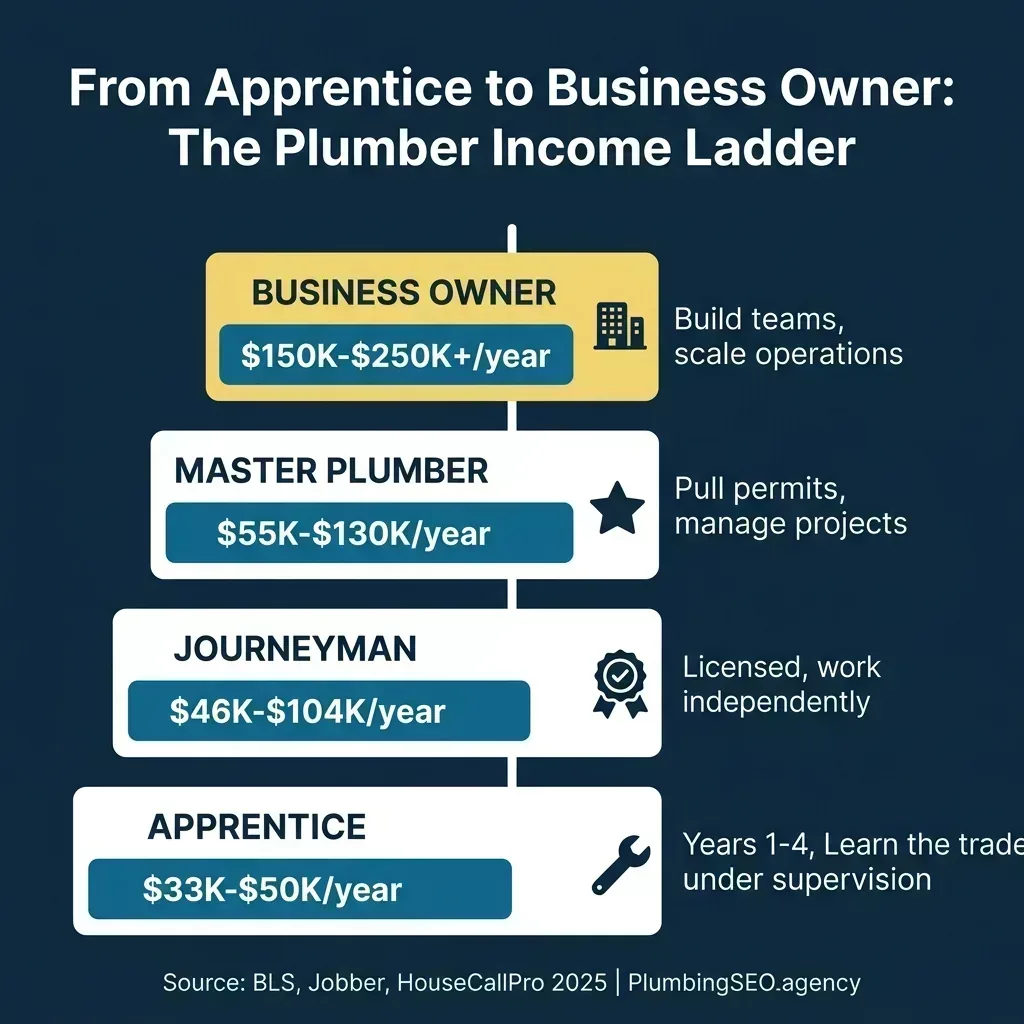
One of the most common questions from people considering the trades is simple: what is the paycheck? The answer depends entirely on where you are in your career and whether you are working for someone else or building your own thing.
| Career Stage | Annual Income Range | What It Takes |
|---|---|---|
| Apprentice (Years 1-4) | $33,000 - $50,000 | On-the-job training, learning codes and techniques under a licensed plumber |
| Journeyman | $46,000 - $104,000+ | State exam passed, can work independently, supervise apprentices |
| Master Plumber | $55,000 - $130,000+ | Can pull permits, manage projects, operate independently |
| Business Owner | $150,000 - $1,000,000+ (Tas Plumbing example: $2.6M+ run rate) |
Build systems, hire teams, manage operations and marketing |
| Top Commission Plumber | $100,000 - $350,000+ | High-volume service work, 100% efficiency, strong communication |
Dustin's story illustrates one of the most striking data points from his interview: a 15-year bank manager left his career, became a plumber's apprentice, and is now making triple his previous bank salary. No college degree required. No student debt. Just willingness to work hard and learn.
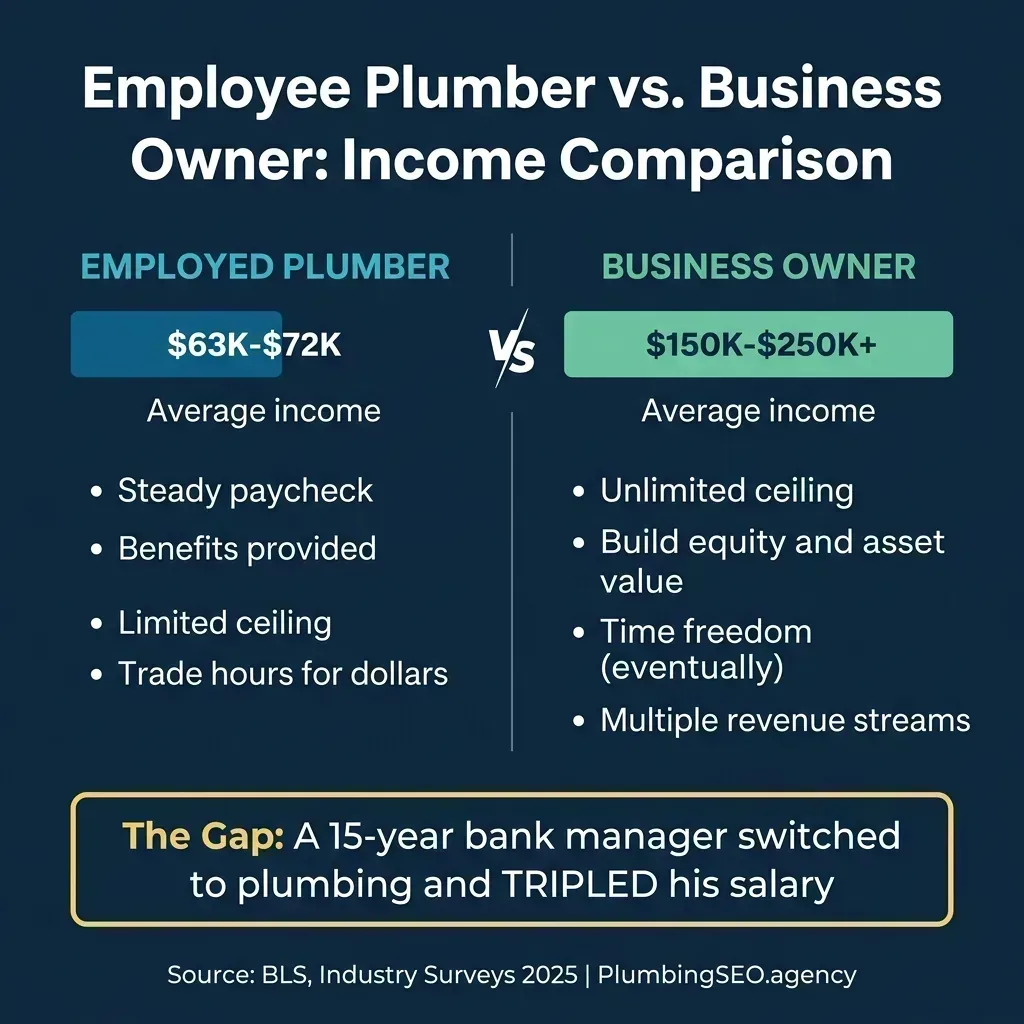
But here is the part nobody talks about: Dustin, as a new business owner just 10 months in, is currently taking home less than he made as an employee. He pays himself a modest salary - enough to cover the household bills and his kids' cheerleading expenses - and reinvests everything else. Even in weeks where Tas Plumbing generates $50,000 in revenue (which extrapolates to a staggering $2.6 million annual run rate), his personal pay does not change.
That discipline is what separates the plumbers who build real wealth from those who just earn a good living. As Dustin puts it: "People are like, ‘why haven't you moved into a bigger house?’ I'm good. I like my house." He sold the Escalade. He downsized from the big house. He gave up the luxuries so the business could grow.
Starting Tas Plumbing: What It Really Takes to Open a Plumbing Company
After years of being the top producer at every company he worked for, Dustin realized something that eventually hits every high-performing tradesman: he was making corporations rich. The long commute into Dallas, the rat race on I-30, being away from his family in Hunt County - it all added up. And the community where he actually lived had no access to the kind of excellent service he was providing to Dallas customers.
So he and his wife Amelia launched Tas Plumbing. He describes it as a leap of faith - "a mustard seed" - but one backed by years of preparation.
The First Steps Dustin Took
- LLC setup and business structure: Amelia handled the business formation. Dustin is candid about his weakness here: "As far as ignorance is concerned, I would be the last guy you want to take business advice from." She is the brains behind the operation.
- Leveraged his existing tool investment: Every tool he had bought over the years as an employee went straight into his truck. That years-long habit of investing in better equipment paid off on day one.
- Insurance: Business insurance was a non-negotiable first expense. "Always a wise investment," he emphasized.
- Master plumber compliance: Making sure his license numbers were on the side of the truck and he was fully compliant from the start.
- Downsizing personal lifestyle: The big house, the Escalade, the cool trucks - all had to go. "We knew in order to come into Tas that we had to cut some of that stuff back because it was not going to be sustainable."
Ten months in, Tas Plumbing supports 12 families through employment. They are adding to the fleet, adding employees, and constantly innovating with dispatch software, marketing, and technology. Dustin still crawls through crawl spaces in Tyvek suits when the job requires it. "I would never ask anybody to do anything that I am not willing to do," he says.
How to Get Into the Plumbing Trade Right Now
Both Dustin and Roger are actively recruiting people into the trades. Dustin regularly gets Facebook messages and phone calls asking "are you hiring?" - and the answer is often yes. Here is what he and Roger advise for anyone considering plumbing as a career:
If You Are Young (18-25)
- Finish school first. Dustin quit in 9th grade and went back for his GED. He insists his apprentices finish high school. His reasoning is simple: "If you will quit school, you will quit plumbing." It is about commitment, not curriculum.
- Reach out directly. Find local plumbing companies on Facebook, Google, or Instagram and message them. "Don't be too proud to do that," Dustin says. Everybody is hiring right now.
- Show up and work hard. Roger literally recruits at grocery stores. He watches night-shift stockers, and if they are hustling, he approaches them and offers a career path. "What if I told you I could help you get into a career where you can make six figures a year with zero college debt?"
If You Are Changing Careers (25-50)
- Your previous career is not wasted. The bank manager who became a plumber tripled his salary. Car salesmen, dispatchers, and military veterans all bring transferable skills.
- Start as an apprentice. Yes, the pay is lower initially. But within 3-5 years, you will be earning more than most white-collar professionals - with zero student debt and a recession-proof skill.
- Invest in your education from day one. Study 30 minutes to an hour every morning. New tools, new materials, new techniques, new technology. Roger promises: "In a year, you are going to be in the top 5% of your industry."
"Right now to try to get in the trades - there's a million unfilled trades jobs across the United States. Get in and try to be the best. And it's easy to do right now because nobody else is trying. Just try and you can do it."
Watch the Full Conversation: Dustin Deise on The Trade Talk
This entire article was inspired by Dustin's conversation with Roger Wakefield on The Trade Talk podcast. If you want to hear Dustin tell his story in his own words - the humor, the honesty, the raw advice about balancing family and ambition - watch the full interview below.
Key takeaways from the conversation that every plumber - apprentice or owner - should hear:
- Be okay with change. If Dustin could go back and tell his younger self one thing, that would be it. The industry changes. The economy changes. Your role changes. Embrace it.
- Balance matters. Dustin admits he spent years working 100-hour weeks and "buying love" for his family instead of being present. The money was great, but the trade-off was real. Now, with his own company, he has found better balance.
- Nobody is coming to bail you out. On every job, Dustin operates with the mindset that there is no backup. "Figure this out" is his internal mantra. That self-reliance is what makes him exceptional.
- Network with the right people. Suppliers who will deliver parts to you from their trunk at 4 PM on a Friday. Mentors who pick up the phone. Subcontractors who close a job at 5 PM because you have a 10-year relationship. Those relationships are currency.
- Never stop learning. Dustin was cutting cast iron with snap cutters while practicing hammer-and-chisel for his journeyman exam - because his coworkers told him that is what the test required. (It was not. They were messing with him.) The point: always be learning, always be verifying, always be growing.
Growing Your Plumbing Business? Your Website Should Be Your Best Salesperson.
Dustin grew Tas Plumbing through social media, pay-per-click, and search engine optimization. If your plumbing website is not generating calls, you are leaving money on the table. We audit plumber websites for free - no obligations.
Get My Free Plumbing SEO AuditFrequently Asked Questions
Plumbing business owners typically earn between $80,000 and $250,000+ per year, depending on business size, location, and operational efficiency. Solo operators often start in the $40,000 to $100,000 range, while owners of established multi-employee companies regularly earn $150,000 to $250,000+. The key variable is whether the owner is still working in the field or has transitioned to managing the business full-time.
Yes. Many plumbers have built million-dollar businesses and personal net worth through business ownership, strategic reinvestment, and scaling operations. The path typically involves transitioning from trading hours for dollars to building systems and teams that generate revenue without the owner performing every job. Some owners also build wealth through selling their established companies to larger firms or private equity groups.
Plumber apprentices typically earn between $33,000 and $50,000 per year, depending on location and whether they are in a union program. Union apprenticeships often offer structured raises and benefits. The key advantage is that apprentices earn while they learn, avoiding the student debt that burdens many college graduates. Within 4 to 5 years, apprentices can become licensed journeymen earning $46,000 to $104,000+.
A small to mid-sized plumbing business can generate over $1 million in annual revenue. However, revenue and profit are very different numbers. Healthy plumbing companies typically maintain 10% to 20% net profit margins after paying for payroll, insurance, vehicles, fuel, marketing, materials, and overhead. A company doing $1 million in revenue with a 20% margin keeps $200,000 in profit.
No. A college degree is not required to become a plumber. The standard path is through an apprenticeship program (typically 4 to 5 years), followed by passing a journeyman exam. A high school diploma or GED is recommended but not always mandatory for apprenticeships. Many of the most successful plumbers and plumbing business owners, including Dustin Deise featured in this article, built their careers without a traditional college education.
Starting a plumbing business requires a master plumber license (in most states), an LLC or business entity, business insurance, a service vehicle, tools, and a marketing plan. Startup costs typically range from $10,000 to $50,000. Most successful plumbing business owners spend years as employees first, building their skills, tool collection, and professional network before making the leap. Having a strong business partner who handles the operational side (bookkeeping, dispatching, marketing) is a significant advantage.
Ready to Grow Your Plumbing Business Like Dustin Did?
Whether you are a one-truck operation or managing a fleet, your online presence is your most powerful growth engine. We specialize in helping plumbing companies rank higher, get more calls, and turn clicks into booked jobs.
Get My Free Plumbing SEO Audit