
- Social media management for plumbers is not posting random drain memes. It is planning, publishing, replying, and measuring content that makes local homeowners trust you before they call.
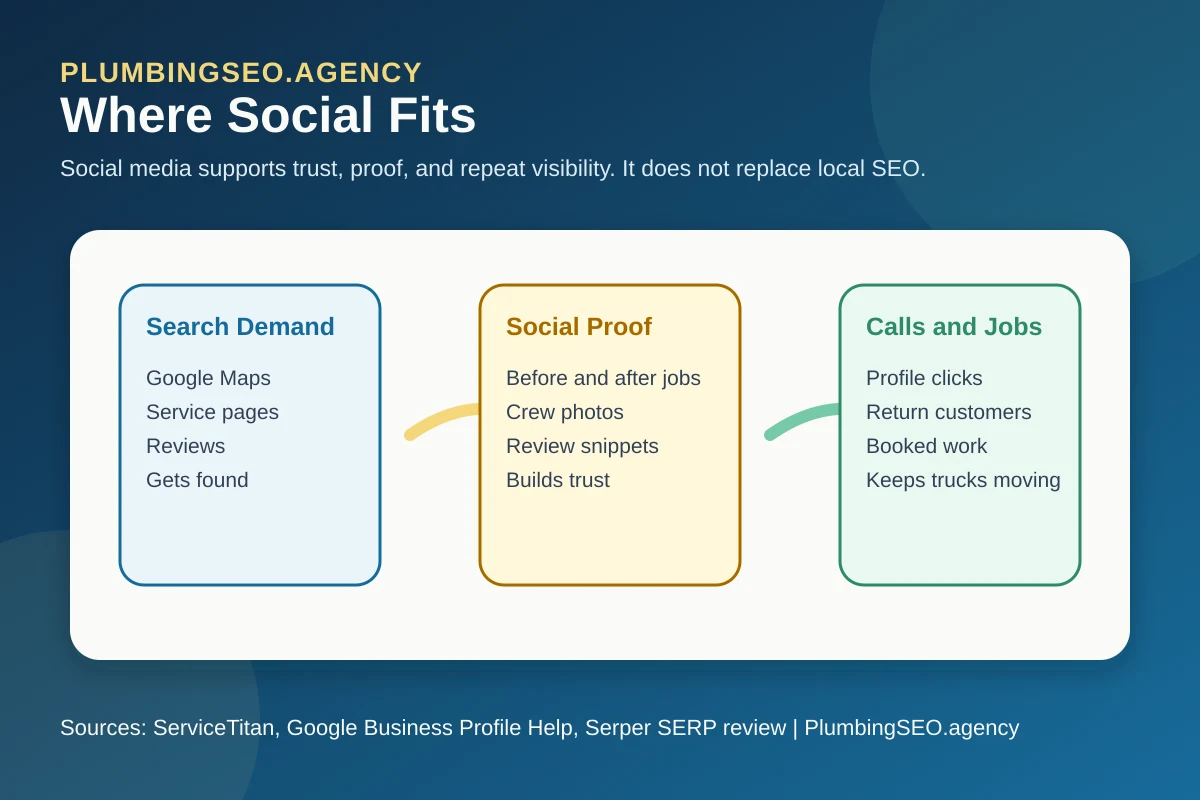
- Use social to prove the work, not replace SEO. Google Maps, service pages, reviews, and local SEO still catch emergency demand when the customer needs a plumber now.
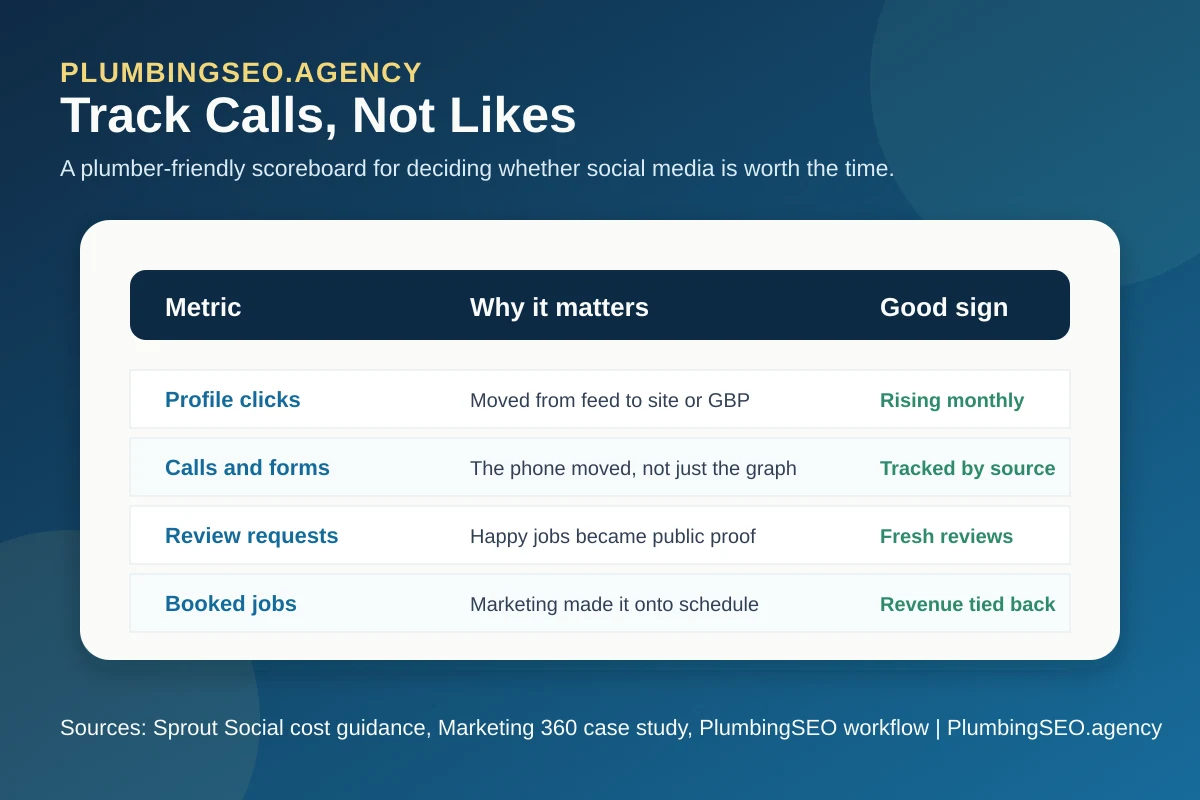
- Track profile clicks, calls, forms, reviews, and booked jobs. Likes are fine, but they do not pay payroll or keep trucks moving.
If your plumbing company is slow, social media can feel like one more thing yelling for attention. The phones are quiet, the crew still needs hours, and somebody online says you need three reels a day, a brand voice, and a content ecosystem. That sounds good on paper. In the real world, you need booked jobs.
So let us clean up the phrase first. Social media management for plumbers means planning what to post, publishing it on the right channels, responding to comments and messages, using reviews and job photos for trust, and checking whether any of it helped people call, click, or book.
If you already know the basics and want a done-for-you commercial route, see our Social Media Management for Plumbers service page. This guide stays educational so it does not compete with the service page.
It is not a magic replacement for SEO for plumbers. It is a support channel. SEO captures people who are already searching. Social helps those people recognize your name, trust your work, and remember you when the water heater gives up at the worst possible time. Plumbing equipment has timing. So do customers.
What Social Media Management Actually Includes
The competitor article that triggered this topic defined social media management in broad marketing terms. That is fine for a glossary, but plumbing is not a broad marketing problem. You are selling trust, speed, cleanliness, proof, and local availability.
For a plumbing company, social media management usually includes:
- Content planning: deciding what gets posted this week and why.
- Publishing: posting on Facebook, Instagram, YouTube Shorts, Google Business Profile updates, and sometimes LinkedIn for commercial work.
- Creative: job photos, short videos, review graphics, team photos, seasonal reminders, and simple educational posts.
- Community management: replying to comments, direct messages, recommendations, and local questions.
- Reputation support: turning happy customer feedback into trust-building posts without sounding fake.
- Reporting: checking clicks, calls, messages, booked jobs, and what content earned attention from the right people.
Google also says Business Profile posts can show updates, offers, events, photos, and videos directly on Search and Maps, and posts may appear in places like the Updates or Overview tabs. That matters because your social content can support the same local trust layer that customers see before they call. Source: Google Business Profile Help.
What Most Generic Advice Misses for Plumbers
Most social media advice treats every business like a lifestyle brand. Plumbers are different. A homeowner does not follow a drain cleaning company because they want daily entertainment. They follow, remember, or check you because they want to know who is safe to let into the house and who can fix the problem without making a bigger mess.
That changes the goal. Your social media should answer owner-side questions like:
- Will this company show up in my area?
- Do they do clean work?
- Are real customers happy with them?
- Do they handle the type of problem I have?
- Can I call, book, or message without hunting around?
That is why social media should be tied to local SEO basics, not separated from them. Reviews, service-area proof, photos, and consistent contact details all work together. If your social pages say one thing, your website says another, and your Google Business Profile is stale, customers feel the leak even if they cannot name it.
The Weekly Content Plan I Would Use First
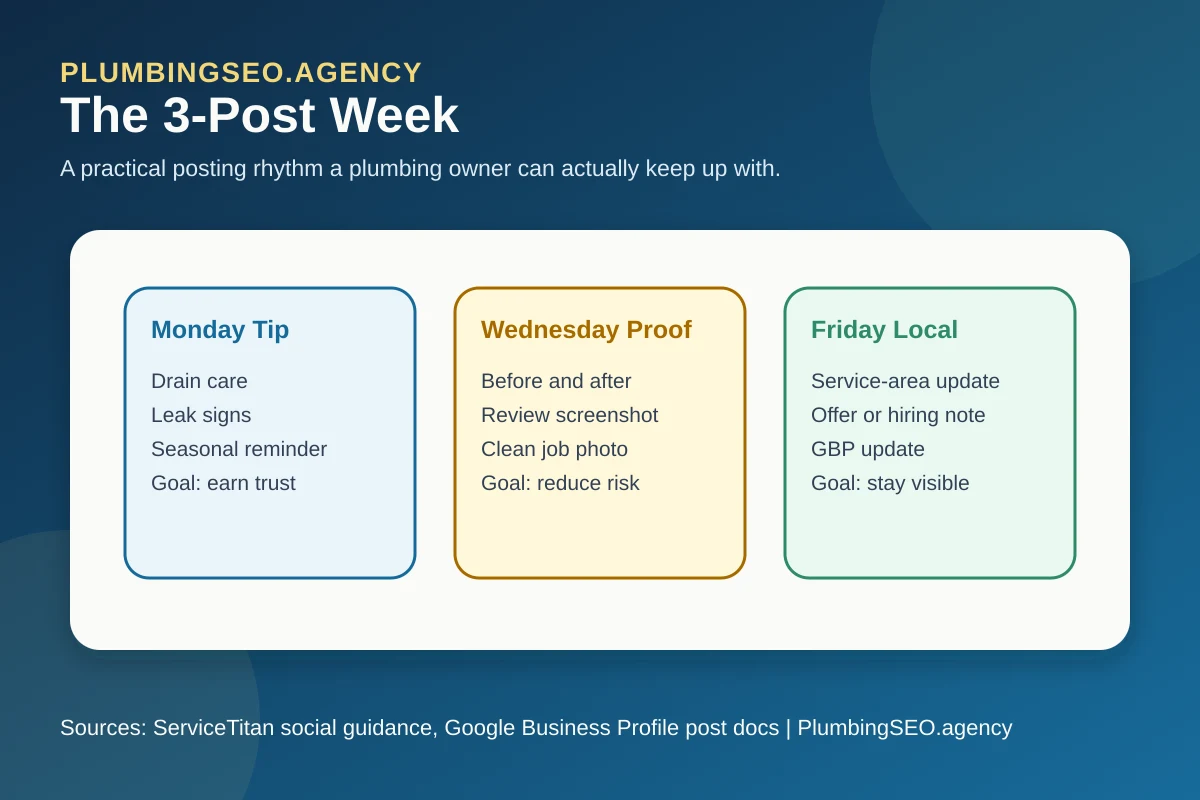
Do not start with seven platforms. Start with a rhythm your office manager, lead tech, or owner can keep without turning the whole company into a media studio. For most shops, three posts a week is enough to build proof and stay active.
Post 1: Helpful plumbing tip
Pick something a homeowner can understand in under one minute. Examples: early water heater warning signs, why drains slow down, what not to flush, when to shut off the main valve, or how to spot a small leak before it becomes a ceiling stain.
This type of post helps because it proves you know the work and are willing to educate. Keep it plain. Nobody needs a 900-word essay on sediment buildup inside a Facebook caption.
Post 2: Proof from the field
Use before and after photos, clean truck photos, team photos, jobsite photos, or customer review graphics. Get permission when needed. Do not show private addresses, messy customer situations, or anything that makes the customer look bad.
This is where plumbing has an advantage over generic industries. Real work is visual. A clean install, a tidy work area, and a tech wearing boot covers says more than another stock photo of a wrench.
Post 3: Local trust or offer
Post a service-area note, a seasonal reminder, a hiring update, a limited offer, or a Google Business Profile update. If you serve Childress, Wichita Falls, Fort Worth, or a specific local area, say it naturally. Local customers need to see that you are nearby, not just online.
What the Research Says About Cost and Expectations
Social media management pricing varies wildly. Sprout Social's 2026 cost guide says basic social media management can run from $500 to $5,000 per month, while launching and creating content for a new channel can cost $500 to $10,000 per month depending on scope. Source: Sprout Social.
For a local plumbing company, that does not mean you should automatically spend $5,000 a month on social. In my opinion, most plumbers should fix the foundation first: Google Business Profile, website conversion, call tracking, reviews, and service pages. Then use social media to amplify proof.
| Option | Typical use | Best fit | Watch out for |
|---|---|---|---|
| DIY | Owner or office posts 2 to 3 times weekly | Solo shops and early-stage companies | Consistency drops when the schedule gets busy |
| Freelancer | Graphics, scheduling, light captions | Shops with good photos and clear direction | May not understand plumbing search intent |
| Agency | Strategy, creative, reporting, paid social | Growing companies with tracking already in place | Vanity reports that hide weak lead quality |
Can Social Media Produce Plumbing Leads?
Yes, but it depends on the market, offer, tracking, and whether the rest of the business is ready to catch the lead. One public Marketing 360 case study reported that a California plumber saw 177K impressions, almost 2K clicks, and dozens of conversions over three months, with a 1,414% increase in clicks compared with the previous period. That is useful evidence, but it is also a case study, not a guarantee. Source: Marketing 360.
Here is the problem. Social can create attention, but attention still has to turn into a call. If your website is slow, your phone number is buried, your reviews look weak, and nobody answers messages quickly, the post did its job and the business dropped the handoff.
That is why I would not judge social by likes alone. I would judge it by whether it supports the real pipeline: profile click, call, form, booked job, repeat customer.
What to Post: Plumber-Specific Ideas That Do Not Feel Forced
ServiceTitan's plumber social media guide points to common post types like videos, informational content, customer reviews, behind-the-scenes posts, and review encouragement. That lines up with what works for local trust. Source: ServiceTitan.
Here are practical ideas your team can collect during normal work:
- Before and after: clean water heater replacement, tidy repipe section, drain line issue fixed.
- Seasonal reminders: winter pipe protection, water heater flush reminders, sump pump checks, holiday disposal warnings.
- Trust posts: licensed team, clean trucks, parts on hand, background-checked techs if true.
- Review posts: screenshot one strong review and add a short thank-you.
- Problem explainers: why a toilet keeps running, why low water pressure can have several causes, why chemical drain cleaner can make things worse.
- Local posts: neighborhoods served, community involvement, storm or freeze response reminders.
Keep the camera steady, the message plain, and the call to action clear. Do not turn every post into a hard sell. If every caption screams "call now," people tune it out faster than a helper asked to dig in August.
Where SEO Should Come First
If a homeowner has water on the floor, they are not scrolling Instagram for inspiration. They are searching. That is why your foundation still needs to be Maps, organic search, and a website that turns visitors into calls.
Social should come after the basics when:
- Your Google Business Profile is verified, accurate, and active.
- Your website has service pages for the work you want.
- Your phone number is visible on mobile.
- Your reviews are current and responded to.
- You can track calls, forms, and booked jobs by source.
If those pieces are not covered, start with an SEO and conversion cleanup. Our advanced local SEO guide for plumbers explains the local search side in more detail.
When Paid Social Makes Sense
Paid social can help with retargeting, seasonal offers, recruiting, brand awareness, and keeping your name in front of homeowners in a tight service area. It is usually weaker for emergency plumbing intent than Google Ads or Local Service Ads because the customer is not always looking right now.
Use paid social when you have a clear offer and a clean landing page. Good examples include water heater inspections before winter, drain cleaning reminders before holidays, hiring campaigns, or retargeting people who visited your service pages but did not call.
Do not use paid social as a blind replacement for search. If the phone is quiet this week and you need calls now, Google Ads or Local Service Ads may be the faster lever. Social is more like keeping your truck clean and visible around town. It helps, but it is not the whole business.
A Simple 30-Day Implementation Checklist
- Pick two channels: usually Facebook and Google Business Profile first, then Instagram if your team can capture photos.
- Create a shared photo folder: job photos, team photos, trucks, reviews, and approved customer proof.
- Write a three-post weekly calendar: one tip, one proof post, one local update.
- Add tracking links: use tagged links where practical and make sure calls are tracked.
- Set response rules: who replies to comments and messages, and how fast.
- Review results monthly: profile clicks, calls, forms, booked jobs, and review growth.
- Cut what does not work: if a post type never earns useful action after a fair test, stop feeding it.
Need a second set of eyes on the whole marketing setup? Contact us or start with a free SEO leak check. We will show you where calls are leaking before you spend more money on another channel.
Frequently Asked Questions About Social Media Management for Plumbers
It helps a plumbing business build trust before the call. Good social media shows real jobs, real reviews, real service areas, and helpful advice. It works best when it supports Google Business Profile, reviews, local SEO, and a website that converts visitors into calls.
Many plumbers can handle the basics themselves with a simple three-post weekly calendar. Hire help when you need better creative, consistent scheduling, paid social, reporting, or when the owner's time is worth more in operations and sales than writing captions.
You can see engagement and profile clicks within a few weeks, but lead quality usually needs 60 to 90 days of consistent posting and tracking. For most plumbing companies, social media compounds as reviews, photos, repeat visibility, and retargeting stack together.
Post helpful plumbing tips, before and after job photos, review highlights, seasonal reminders, team photos, service-area updates, and simple videos that explain common homeowner problems. Keep it useful and local. Avoid filler posts that do not build trust or drive action.
No. Social media and SEO do different jobs. SEO captures people actively searching for a plumber. Social media builds proof, trust, and repeat visibility. If you have to choose one first, most plumbing companies should fix local SEO, Google Business Profile, website conversion, and call tracking before spending heavily on social.
A small plumbing company can start with DIY posting and a low tool budget. Paid help often ranges from a few hundred dollars per month for basic scheduling to several thousand for strategy, creative, paid social, and reporting. Spend more only when you can track calls and booked jobs back to the work.
Want More Calls, Not More Noise?
Get a free SEO leak check. We will show you whether social media, local SEO, reviews, website fixes, or tracking should be the next move for your plumbing company.
Run My Free SEO Leak Check