
- The quickest way to grow calls is not by adding more channels; it is by aligning profile, website, reviews, ads, and reporting so every marketing dollar ties to booked jobs.
- Start with a strong local foundation (Google Business Profile, service pages, and trust signals), then scale paid and content channels based on what actually converts.
- Track leads by source, booked jobs, and cash result so teams know what to cut, keep, and repeat each 30-day cycle.
A lot of plumbing marketing posts in 2026 still look like generic checklists: build an ad, post often, publish blogs, then wait. For a plumber, that approach often fails because your business does not sell the same way as an online coach, a fashion brand, or a SaaS startup. You sell urgency, service availability, and trust.
That means your digital marketing system should be built around one question: Will this move make your business easier to find, easier to call, and easier to trust? When the answer is yes, you should do it. When the answer is no, move on.
Why this matters for plumbing companies now
Plumbing is a high-intent business. A homeowner may search for a drain unclogging service while water is still rising in their home. If your listing is weak, your page is slow, or your reviews are unclear, competitors with better marketing systems win that call.

What the generic topic misses for plumbers
Most broad digital marketing content says to “do SEO, PPC, and social.” That is directionally correct, but it is incomplete for plumbing owners. Generic posts usually skip operational constraints: dispatch response speed, service-area limits, emergency urgency, and repeat-work value.
Without those constraints, you get activity without traction: traffic increases while booked jobs do not. A plumber should instead optimize each channel to support the same funnel:
- Discovery: be visible for the right local queries and service intent.
- Trust: show real proof, transparent reviews, and service readiness.
- Action: make calling and booking frictionless on phone and mobile.
- Action-to-revenue: track source, lead quality, and booked work.
Research-backed foundations you should prioritize
Google Business Profile guidance is clear that complete and accurate business information helps local ranking, and local results rely on relevance, distance, and prominence signals. That is why profile completeness, reviews, and location details matter early. Google Business Profile local ranking support summarizes these core factors.
Where plumbers go wrong
Most owners push paid ads before their profile and landing flow are ready. In plumbing, a strong paid channel without a call-focused landing system is a common way to buy leads you cannot convert efficiently. The same logic applies in reverse: a perfect profile without tracking still leaves budget decisions blind.
10 practical benefits of digital marketing for plumbing businesses
| Benefit | What it changes for plumbers | How to implement first | What to watch |
|---|---|---|---|
| Higher local discoverability | More nearby homeowners see you for “plumber near me” and emergency service needs. | Claim, verify, and fully complete Google Business Profile categories, hours, services, and photos. | Profile views, map appearances, call clicks. |
| Faster response to emergency demand | Calls during urgent windows move from missed to answered. | Add one-tap click-to-call on service pages and ensure staff can receive alerts within response SLA. | After-hours calls, missed calls, call duration to first action. |
| Lower wasted spend | Marketing budgets are assigned to channels that prove booked-work value. | Use call and form tracking before scaling ads and stop channels that do not produce booked work. | Cost per booked job, cost per lead by channel. |
| Better relevance and trust | Homeowners choose the plumber with clear service proof and nearby relevance. | Build service pages tied to exact offers: leak repair, sewer, water heater, drain cleaning. | Service-level conversion by city/service page. |
| More repeat work | Existing customers stay in your pipeline instead of searching for competitors. | Set up post-job follow-up and seasonal reminder content. | Repeat-call ratio, review requests sent, maintenance bookings. |
| Stronger planning from data | Managers can predict lead flow, not just traffic. | Create a monthly source-to-booking dashboard. | Channel source, job value, lead-to-booked rate. |
| Lower uncertainty for owners | More reliable decisions for owners who run both crews and marketing. | Share a single KPI set with your team weekly. | Booked calls by source, canceled call rate, dispatch load. |
| Faster growth with consistency | One improvement week leads to measurable lift instead of random spikes. | Use a 30-day execution rhythm and track exactly what changed. | Before/after call quality and visibility metrics. |
| Better ad performance | Better ad assets and clearer pages reduce wasted spend and raise quality. | Follow Google Ads responsive ad best-practice guidance and test ad assets/strength. | Ad strength, click-to-call quality, conversion rate. |
| Competitive protection | Reduces dependence on one platform or one lead source. | Balance organic local visibility, paid channels, reviews, and referral workflows. | Revenue diversity by source and repeat-job mix. |
Step-by-step implementation checklist (90-day)
Days 1 to 30: remove obvious leaks
- Update Business Profile with complete, accurate service and contact details.
- Update or build top service pages with clear emergency intent copy.
- Add one-tap call buttons on every high-intent page and test from mobile.
- Set up at least one call-source dashboard for daily monitoring.
Days 31 to 60: prove relevance
- Create local proof (job photos, service examples, review snippets).
- Improve page speed and schema continuity for local/FAQ markup.
- Request reviews from recent completed jobs and post with context.
- Link service pages to the homepage for deeper broad plumber SEO brand context.
Days 61 to 90: scale what works
- Start/adjust paid channels only for high-intent service queries.
- Use Google ads guidance on responsive search ad structure, ad assets, and conversions.
- Build a repeat-work loop with seasonal offers and maintenance reminders.
- Review channel scorecards and transfer budget to best performers.
Source: Google Ads best-practice guide.
How to prioritize channels when every vendor says their channel matters
The hard part for a plumbing owner is not understanding that digital marketing can help. The hard part is choosing what to fix first when an SEO vendor, an ad platform, a social media consultant, and a lead seller all claim they should get the next dollar. The safest answer is to rank every channel by how close it sits to a booked job.
Start with the paths that already show buying intent: your Google Business Profile, your homepage, your core service pages, emergency call buttons, and the tracking that proves which source created the call. These assets affect both organic and paid performance. If they are weak, paid clicks cost more than they should, SEO traffic leaks before a call happens, and social posts create awareness without enough conversion support.
For plumbing companies, this is also where broad SEO for plumbers decisions should stay clean. If a guide is talking about the overall marketing system, the next step should be the main agency/homepage promise, not a thin duplicate route. Specific pages can then explain pricing, process, local SEO, technical fixes, and audit details when the owner is ready for the next layer.
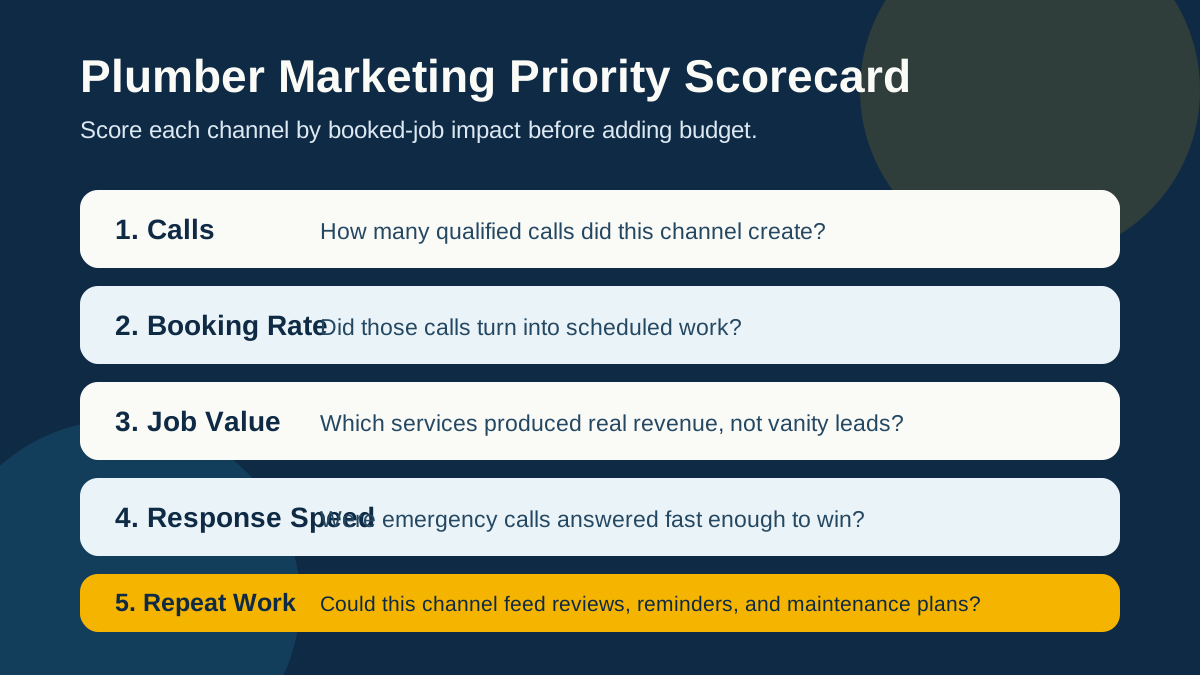
The calls-first scoring rule
Give every channel a simple score from 1 to 5 for five questions: did it create qualified calls, did those calls book, what was the job value, did your team answer quickly enough, and can the channel feed repeat work or reviews? A channel that scores well on all five deserves more budget. A channel that creates clicks but fails at booked work needs repair before scale.
Where the homepage fits
For broad plumbing SEO and plumber SEO intent, keep the homepage as the authority hub instead of sending owners to a duplicate or missing route. Link supporting blog content back to the homepage when the next step is a broad agency evaluation, then use service pages for specific deliverables such as local SEO, technical SEO, service-area pages, or tracking. That keeps the path clear for both search engines and plumbing owners: learn the concept in the article, confirm the agency fit on the homepage, then request an audit when the numbers justify action.
Homepage vs service pages: the clean route for broad plumbing SEO searches
A plumbing company researching general growth usually has a broad question first: who understands plumber SEO, local search, maps, and conversion well enough to create more booked calls? That broad evaluation belongs on the homepage because the owner is choosing the agency and the operating model, not one isolated tactic. A narrow service page is useful after the owner knows which part of the system needs work.
Use this routing rule inside your own site too. Link broad education articles to the homepage when the anchor is about plumber SEO strategy, plumbing SEO agency fit, or the overall system. Link to deeper service pages when the anchor is about a specific deliverable such as Google Business Profile, service-area page structure, technical cleanup, pricing, or tracking. That prevents search engines and readers from seeing multiple pages compete for the same broad promise.
- Homepage: broad agency fit, overall SEO for plumbers strategy, proof, outcomes, and the primary audit CTA.
- Process page: how the work gets prioritized, measured, and executed across maps, website, content, and tracking.
- Pricing page: budget expectations, scope boundaries, and what should be included before signing.
- Audit page: the first diagnostic step when the owner wants a practical next-action list.
A practical order for most plumbing companies
- Fix profile and homepage trust first: accurate service areas, visible phone number, reviews, proof, and one clear audit or booking CTA.
- Fix top service pages second: drain cleaning, water heater, sewer, emergency plumbing, and any high-margin specialty that deserves its own conversion path.
- Use ads third: run paid demand only when calls can be tracked back to the keyword, ad, landing page, and booked job.
- Use content fourth: publish answers that support service-page relevance, owner education, and internal links to the correct hub.
- Build retention fifth: follow-up, review requests, maintenance reminders, and seasonal campaigns improve the value of every lead source.
Measurement and next actions
Digital marketing should not be optimized around clicks alone for plumbing. The real scorecard includes lead source, lead quality, booked job, average ticket, and repeat value. If a channel is generating calls but not booked work, do not just spend more; change the landing path and post-click experience.
Do not let reporting become another generic dashboard either. A plumbing owner needs a short weekly view that dispatch, office staff, and leadership can understand quickly: calls by source, missed calls, booked jobs, high-value services, review requests sent, and the next fix assigned to one person. That keeps marketing connected to operations. If the report says organic traffic is up but sewer calls are flat, the next action might be a sewer page rewrite, a Google Business Profile service update, or a call-handling correction. If paid calls are up but bookings are weak, the next action is not always more ad spend; it may be better landing-page proof, clearer pricing cues, or faster follow-up.
Common mistakes to avoid
- Running many channels before baseline tracking is active.
- Chasing generic rankings while ignoring emergency conversion paths.
- Measuring visibility without booked-job tie-through to finance.
- Trying to solve everything with ads while the website is not mobile-call ready.
Common questions before you scale
If your team is deciding whether to grow content, ads, or both, start with your constraints. A small office cannot manage every channel deeply, so do the three highest-impact operations first: profile, service-page fit, and conversion tracking.
If you want a structured, plumber-specific implementation plan, review the calls-first SEO for plumbers strategy on the homepage and then align with our team for a dedicated action plan.
Final takeaway: choose the route that supports booked calls
The best digital marketing plan for plumbers is not the one with the most channels. It is the one that makes the next valuable call easier to win, answer, book, and attribute. Keep broad SEO and agency-evaluation links pointed to the homepage, use focused service pages for specific execution details, and judge every channel by whether it improves qualified calls and profitable jobs.
Digital Marketing for Plumbers FAQs
By organizing the same path around local discovery, trust, calls, and booked jobs. Marketing channels are useful only when they consistently increase quality calls and completed jobs, not just impressions.
Many owners can own the basics (profile details, review requests, job photos, content updates). Bring in an agency for technical structure, tracking architecture, ad optimization, and weekly execution discipline.
Emergency calls and paid tests often show lead movement quickly. Local relevance and organic visibility usually improve over a longer cycle, especially when reputation signals and service content mature together.
Most plumbing companies start with a strong local and conversion foundation, then use ads for immediate demand. If tracking is not complete, ads can waste budget and hide the real issues.
Review monthly for a steady KPI set, and weekly for lead-source flow and call response gaps. Plumbers should evaluate booked-job numbers first, then traffic and ranking changes.
Fix the closest path to a booked job first: Google Business Profile accuracy, homepage trust, top service pages, click-to-call behavior, and call tracking. Once that path converts reliably, SEO content, PPC, email, and social can scale with less wasted spend.
Broad SEO for plumbers links should point to the homepage when the reader is evaluating the agency, overall strategy, proof, and next audit step. Use service pages only for specific deliverables such as local SEO, tracking, pricing, or technical cleanup.
Need a plumbing-first marketing plan, not a generic one?
Get a practical call-for-calls review of your profile, service pages, paid channel setup, and tracking so you can cut blind spend and focus on booked work.
Book a Plumbing Marketing Review