
- LSA rankings are driven by trust and speed: letting calls go to voicemail or ignoring messages is the fastest way to kill your position.
- The transition to Google Verified in late 2025 ended the manual dispute system and increased the weight of dashboard actions like booking rates.
- Lapsed insurance certificates, expired business licenses, or competitor budget spikes are common causes of sudden ad invisibility.
The Plumbing LSA Ranking Algorithm: What Matters in 2026
One day the phone is ringing off the hook with high-paying water heater replacements and sewer line jobs. The next day: complete silence. You log in to check your Google Local Services Ads dashboard, only to find your plumbing company has been pushed to the bottom of the list. You are no longer in the top three spots, and the clicks have vanished.
If your Google Guaranteed ranking dropped, you are not alone. With the platform's update to the new Google Verified badge, the ranking algorithm has shifted. Google does not rank local service businesses solely on who has the largest budget. Instead, LSA operates on an auction system heavily weighted toward user experience, response speed, and trust signals.
How Google Measures Proximity to Plumbing Service Areas
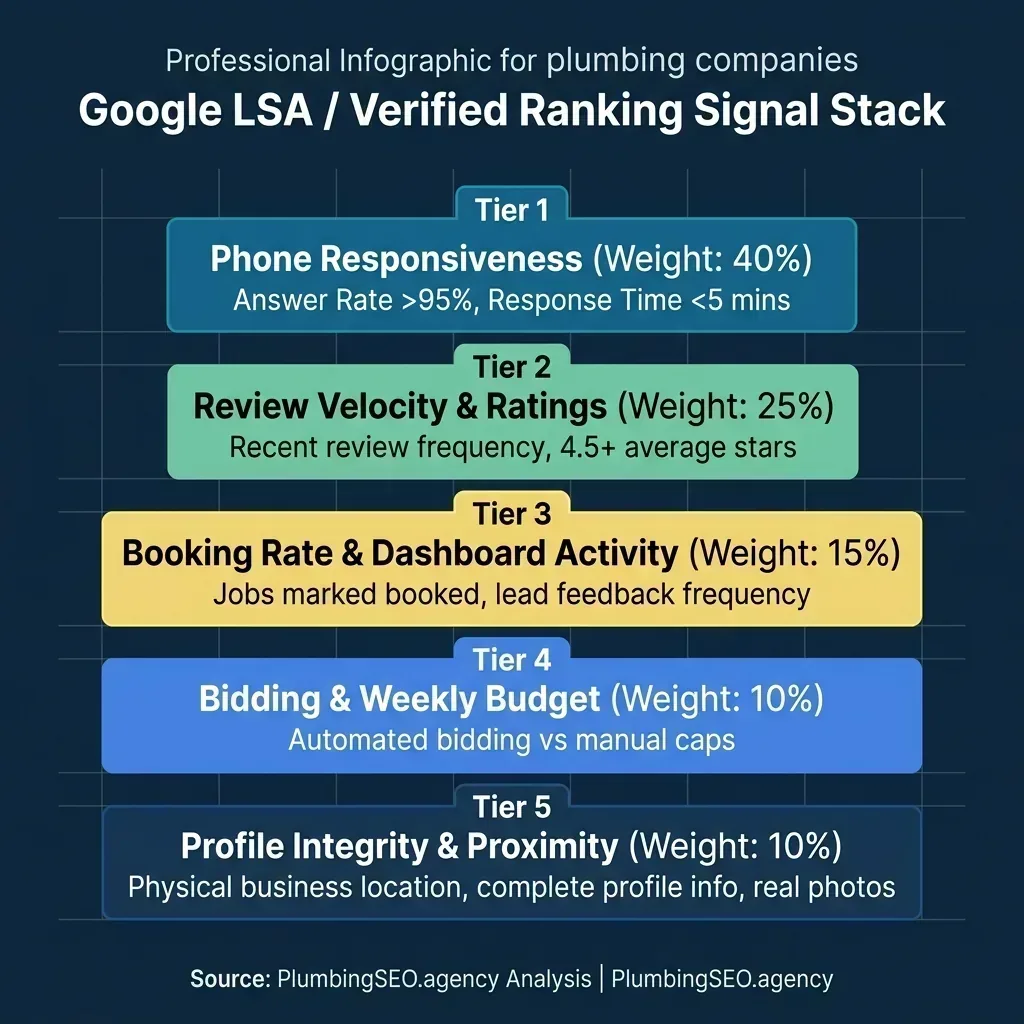
Understanding where you stand in this hierarchy is crucial. The algorithm weighs several factors to determine which plumbing shops get prime placement at the top of the search engine results page:
Why Review Velocity Outweighs Total Review Count
If you have seen a sudden decline in leads, it is likely because your profile has slipped in one of these critical areas. By isolating each ranking signal, you can diagnose where the leak is and get your business back to the top spot.
Reason 1: Missed Plumbing Calls and Poor Responsiveness
If there is a golden rule of Google Local Services Ads, it is this: you should answer the phone. The algorithm explicitly tracks how often your business answers incoming LSA calls and how quickly you respond to text messages. In fact, responsiveness represents nearly 40% of the overall LSA ranking weight.
Why Voicemails Mean Lost Leads for Emergency Plumbers
When Google sends a high-intent emergency lead to your plumbing shop, they expect a human being to answer. If the call goes to voicemail or rings until it disconnects, Google's system flags your account. The algorithm reasons that if you are not answering, showing your ad is a poor experience for searchers. The system will quickly demote your ranking and give the lead to a competitor who answers.
Routing LSA Calls to Backup Dispatchers
Many plumbing business owners run into trouble when they get busy in the field. If your techs are under crawlspaces and you are driving the truck, calls get missed. Even a few missed calls over a 48-hour window can cause your impressions to plummet. To prevent this, successful contractors route LSA lines to a backup dispatcher, hire a dedicated answering service, or set up an automated call-back tool. In the home services business, if you are not the first responder, the customer has already moved on to the next plumber on the list.
Reason 2: Neglecting Your LSA "Booking Rate" and Job Updates
For years, many plumbing business owners treated the LSA dashboard as a passive receipt list. They would log in to check the billing charges, but they rarely updated the status of their leads. In the current LSA system, that neglect is a ranking killer.
How Google Tracks Your Booking Conversions
Google's system relies heavily on a metric called the **Booking Rate**. This is the percentage of leads that you mark as "Booked" in your LSA dashboard. If Google sends you 20 leads in a month, and you leave them all sitting in the "Active" column, the algorithm assumes your business is failing to convert their traffic. To maximize their own ad revenue, Google will show ads from plumbers who actively book jobs and generate results from LSA clicks.
Managing the LSA Automated Credit Policy
Additionally, the feedback loop changed when Google updated the lead dispute policy. The old manual system, which allowed you to dispute bad leads and wait for manual reviews, has been replaced by an automated credit determination engine. This engine uses AI to analyze call logs and automatically issue credits for invalid contacts. However, you must still guide the system by rating every lead in your dashboard. By clicking "Rate this Lead" and flagging bad matches, you feed data back to the matching algorithm, helping it optimize your targeting and protect your booking metrics.
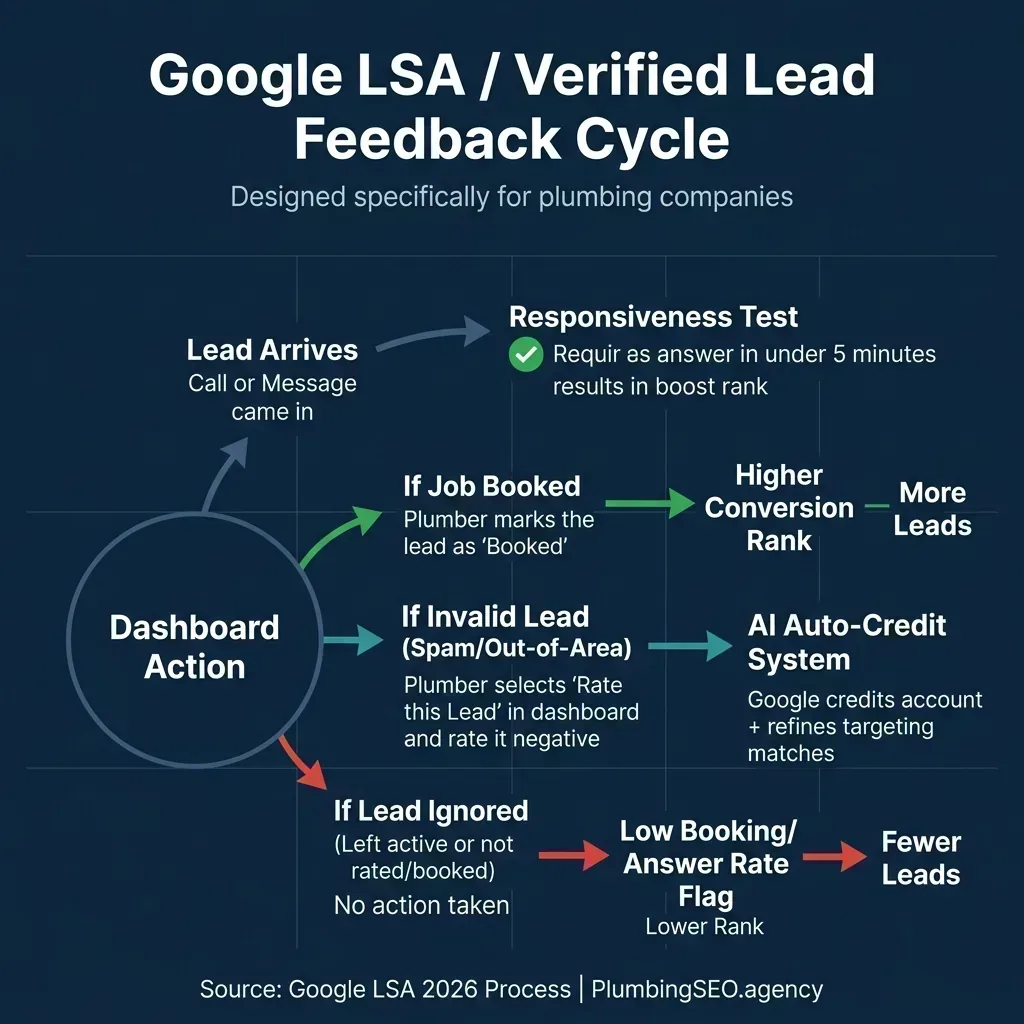
Ignoring this dashboard management can lead to a slow, unexplained drop in rank. If you fail to categorize your leads, Google flags your account as inactive or inefficient. The fix is simple: build a weekly habit of logging in to the LSA portal, updating each call to "Booked" or "Archive," and rating the quality of the interaction. That small admin task keeps your trust score high.
Reason 3: Inconsistent Ad Schedules and Pausing Your Plumbing Ads
It is tempting to pause your Local Services Ads when your schedule gets full. If your crews are booked solid for the next two weeks, you might think the logical step is to toggle the ads off to save money. Unfortunately, toggling your LSA campaign on and off is one of the quickest ways to damage your visibility.
The Traffic Penalty of Toggling Ads On and Off
The LSA algorithm builds a historical profile of your responsiveness. It looks at how consistently you answer calls over weeks and months. When you pause your ads, you halt that history. When you eventually turn the campaign back on, Google does not immediately return you to your previous rank. Instead, the algorithm treats your profile with caution, starting you at a lower visibility level to re-test your response times.
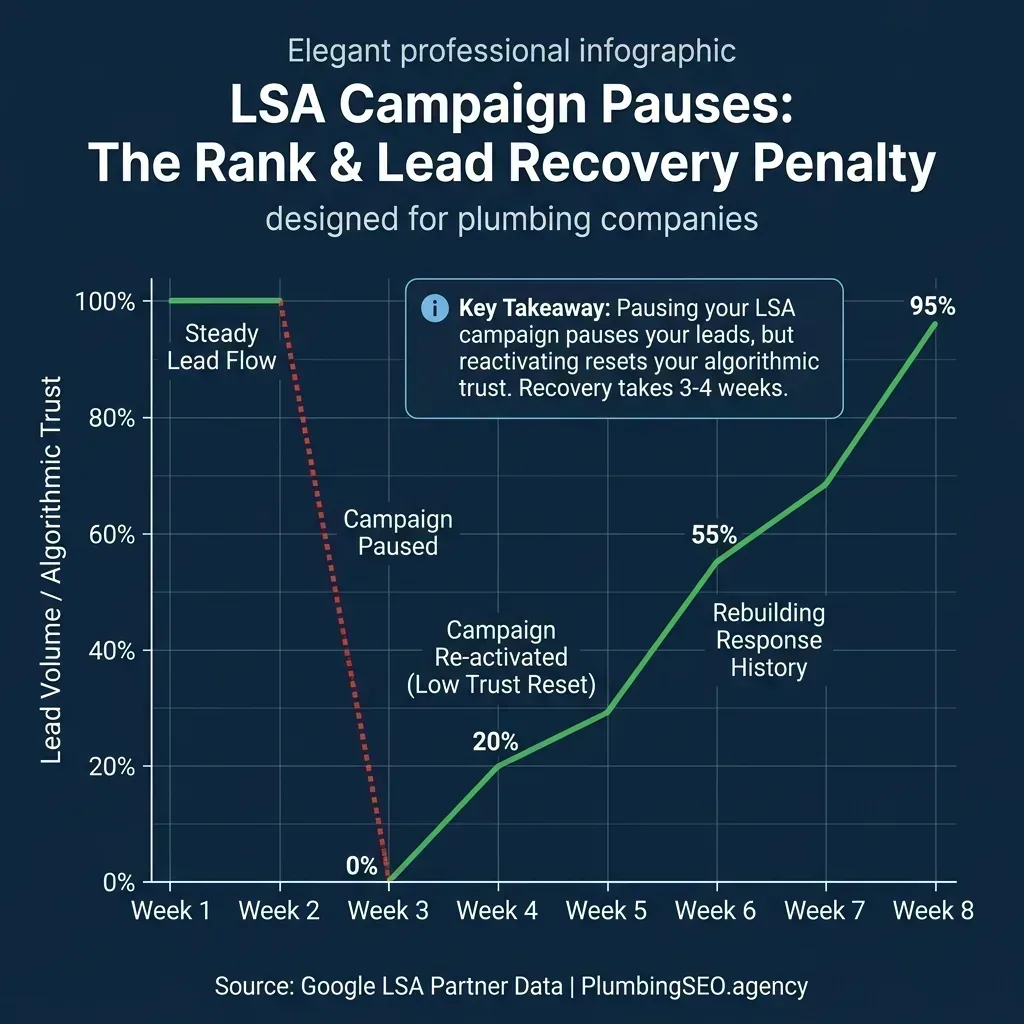
As the data shows, a two-week pause can result in a month-long recovery period where your phone barely rings. Instead of pausing your ads entirely during busy spells, consider lowering your weekly budget or adjusting your service categories. This keeps your campaign active, preserves your ranking history, and prevents the algorithm from resetting your trust score.
Reason 4: Competitor Bidding Shifts in Your Local Plumbing Market
If your responsiveness is perfect and your dashboard is clean, but your ranking still dropped, the issue might be external: your competitors are outbidding you. LSA has moved away from simple flat-rate leads toward an active auction environment.
The Transition to Maximize Leads Automated Bidding
Many contractors set a manual maximum bid per lead when they first set up their account and never adjust it. If your maximum bid is set to $50, but three competitors in your city switch to Google's automated bidding strategy ("Maximize Leads"), their bids will dynamically scale to win the prime top spots. During high-demand periods, their bids might rise to $70 or $80, pushing your manual-capped ad completely out of the top three positions.
To stay competitive, you must review your budget and bidding strategy. If you are in a highly competitive metro area, running at the bottom of the budget range will make you invisible. Here is a look at the standard weekly budgets required to compete in typical markets in 2026:
| Plumbing Subcategory | Average Cost Per Lead | Recommended Starter Weekly Budget |
|---|---|---|
| Emergency Sewer & Drain | $65 - $95 | $650 - $1,000 |
| Water Heater Replacement | $60 - $90 | $600 - $900 |
| General Plumbing Repair | $45 - $70 | $450 - $700 |
| Water Treatment Systems | $50 - $80 | $500 - $800 |
If your budget is set too low, your ad will hit its limit early in the week or get throttled by the system. If you suspect competitor bidding is the cause of your drop, try switching your campaign to "Maximize Leads" for two weeks to see if your impressions and call volumes recover.
Reason 5: Expired Plumbing Licenses and Insurance Credentials
Sometimes, a drop in LSA ranking is not a gradual slide: it is a sudden blackout. If your ads stopped running entirely overnight, the issue is often a verification block.
Google Local Services Ads requires you to maintain up-to-date business documentation. If your general liability insurance policy expires or your state plumbing license is up for renewal, Google's automated compliance checker will flag your account. The moment a document passes its expiration date, Google pauses your ad serving. There is no warning period and no grace period. Your profile simply goes dark until you upload the renewed certificate.
Name, Address, and Phone (NAP) Verification Mismatches
Another common trap is a Name, Address, and Phone (NAP) mismatch. In late 2025, Google consolidated its verification badges (Guaranteed, Screened, and License Verified) into a single unified **Google Verified** badge. At the same time, Google aligned LSA profiles more tightly with Google Business Profiles. If the legal business name on your LSA background check documents does not match the public name on your GBP listing, Google may flag the profile for suspicious activity, resulting in an immediate drop in ranking or temporary account suspension.
Reason 6: Technician Background Check Failures and Employee Turnover
While compliance checks for licensing and insurance are well-known, technician background checks are a hidden compliance trap that frequently causes sudden LSA ranking drops or silent campaign pauses.
The Annual Recheck Trap
Google requires annual background checks for all field technicians who visit customer homes. This verification is managed by third-party background check providers. If you have five service technicians listed on your LSA account, and one of them fails to complete their annual recheck within Google's compliance deadline, Google's system may automatically pause your entire campaign. You will not necessarily receive a notification; your ads will simply stop displaying to local homeowners.
Failing to Add or Remove Staff
When a technician leaves your plumbing company, you must immediately remove them from your LSA team dashboard. Conversely, if you hire new technicians and send them out to LSA-generated jobs without first submitting their details for background checks, you risk account suspension if Google conducts a random audit or if a customer files a complaint. Keeping your LSA team roster perfectly synchronized with your active field staff is vital to maintaining your account's trust status.
Reason 7: Sudden Drops in Google Business Profile Review Velocity
It is a common misconception that having a large volume of reviews is enough to secure your LSA ranking. While a high lifetime review count is valuable, the algorithm places significant weight on review velocity: the frequency and recency of your incoming reviews.
The Review Feed Sync
Your LSA rating and review count are pulled directly from your synced Google Business Profile. If you have 300 reviews but have not received a new one in the last 30 days, your LSA profile signals to the algorithm that your business may be less active. Competitors who receive three to four new reviews per week will quickly outpace you in the ranking position, even if their total lifetime review count is lower than yours.
Handling Negative Review Strings
A sudden string of negative reviews on your Google Business Profile has a double-impact on LSA. First, it immediately lowers your visible star rating, causing your ad's click-through and conversion rates to drop. Second, this drop in consumer engagement signals the algorithm that your listing is less helpful to searchers, prompting Google to reduce your ad's visibility in favor of highly-rated competitors.
Reason 8: Service Area Proximity and Google's Geofencing Filters
Physical proximity to the searcher is a foundational ranking signal in all local search products, and Local Services Ads are no exception. Google wants to show searchers the closest verified business to ensure fast service delivery.
The 15-Mile Proximity Filter
If your plumbing shop is physically located in a suburb, and you set your LSA service area settings to cover a wide 30-mile radius, you may find that you rank number one within a 5 to 10-mile radius of your office, but drop off the page entirely for searches originating from the downtown core. Google's proximity filter can act as a silent block, throttling your visibility in areas further from your registered physical address if local competitors are closer.
County-Wide vs. Postal Code Targeting
Many plumbing contractors default to broad county-wide targeting in their LSA setup. This often dilutes your local rank because Google struggles to align your profile with specific local search intent. Deleting large county-wide areas and replacing them with specific city names or a list of high-value postal codes (zip codes) helps the matching algorithm target high-intent local queries more effectively, boosting your ad prominence in those key areas.
Select your symptoms below to diagnose why your Google Guaranteed ranking dropped and get a step-by-step recovery plan.
Step 1: What is the primary symptom your plumbing shop is experiencing?
The Plumber's LSA Recovery Playbook: 8 Steps to Regain Your Ranking
If your ranking has dropped, do not let your lead volume dry up. Use this comprehensive diagnostic audit and recovery playbook to identify where the leak is and restore your local search prominence.
LSA Dashboard Diagnostic Audit
Before making changes, run an audit of your LSA dashboard metrics to pinpoint the exact failure point:
| Metric to Audit | Warning Threshold | Required Recovery Action |
|---|---|---|
| Call Answer Rate | Below 90% | Route LSA calls to a live dispatcher or professional answering service immediately. |
| Lead Booking Rate | Below 35% | Log in to the dashboard weekly and mark active leads as "Booked" or "Archived." |
| Review Velocity | 0 reviews in 14 days | Launch an automated SMS review campaign to recent customers using your synced GBP link. |
| Lead Feedback Rate | Unrated active leads | Use the "Rate this Lead" feedback tool for all calls to train the automated credit matches. |
| Ad Impression Volume | Below 1,000 / week | Switch from manual bidding to Maximize Leads and refine service area postal codes. |
Once you have diagnosed the primary bottleneck, execute these steps systematically to restore your position and push your profile back to the top of Google:
- Check Your Compliance Dashboard First: Log in to the LSA portal and navigate to the business verification section. Ensure every license, insurance policy, and background check is green and active. Upload any pending renewals immediately.
- Audit Your Missed Calls: Pull your LSA call log. Filter by "Missed" or look for calls with zero duration. If you find missed calls, review your call routing settings. Make sure your lines are routed to a live phone or answering service that is active during your listed hours.
- Clean Up Your Dashboard: Go through your active leads list. Mark every closed job as "Booked" to feed the algorithm positive conversion signals. Rate the quality of any invalid calls to train the automated credit system.
- Switch Bidding to Maximize Leads: If you are using manual bidding and have seen a drop in volume, change your bidding mode to Maximize Leads. Run this automated bidding strategy for two weeks to see if Google's system repositions your ad above competing bids.
- Run a Review Campaign: Reach out to recent customers and request Google reviews. Since GBP reviews feed directly into your LSA profile, increasing your review count and rating velocity is a powerful way to climb the ranks.
- Align Your Profile Names: Check your LSA dashboard name against your Google Business Profile name. If they do not match, update them to prevent NAP consistency flags that hurt algorithmic trust.
- Sync and Audit Technician Background Checks: Verify that all staff members listed on your profile are active and have completed their background rechecks. Remove former employees to prevent compliance flags.
- Geofence with Specific Postal Codes: Delete county-wide targeting in your dashboard and replace it with specific high-value postal codes or target cities close to your physical address.
By treating LSA as an active lead generation system rather than a set-and-forget ad campaign, you can protect your visibility and keep your dispatch boards full throughout the year.
Google Guaranteed Ranking Drop Recovery Cheat Sheet
To help you keep these compliance rules and ranking factors top of mind, we have compiled the entire recovery playbook into a visual cheat sheet. Save this image to your phone or pin it in your office to keep your dashboard in the green:
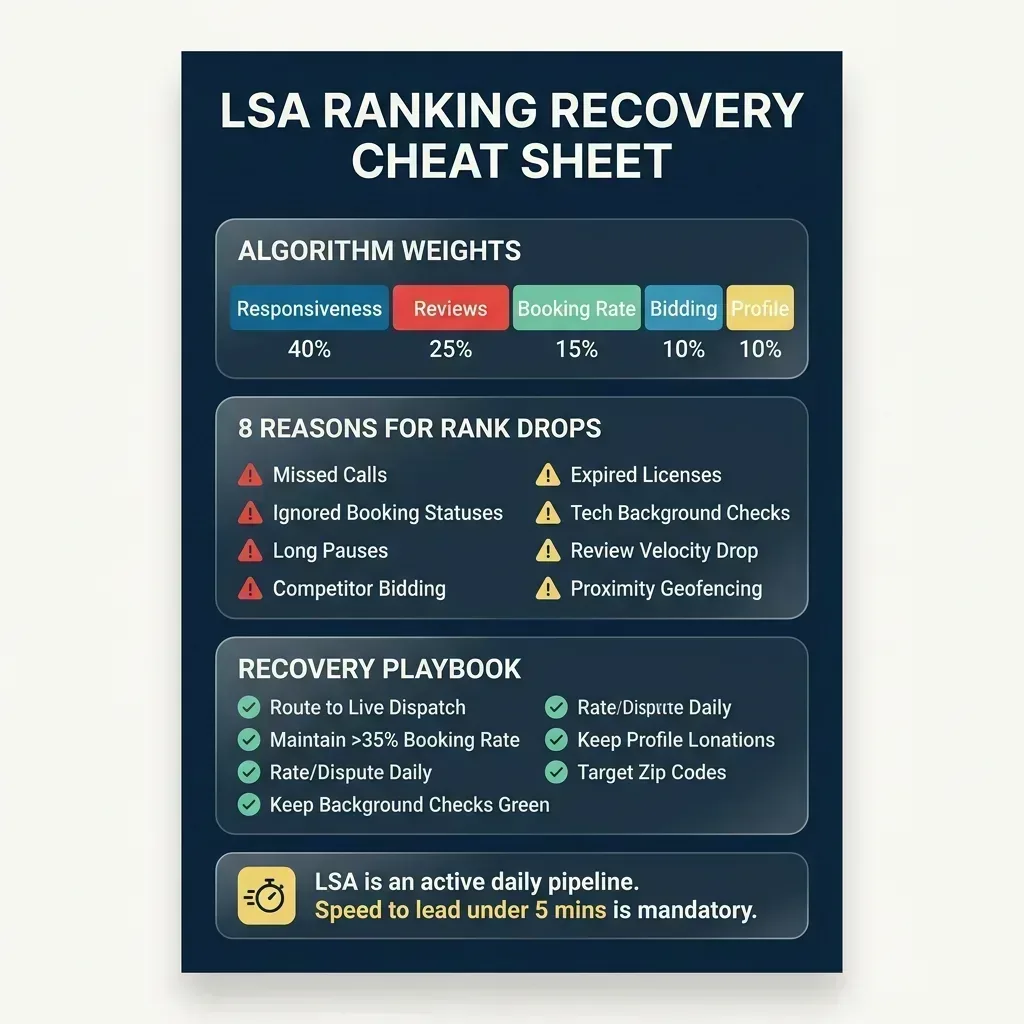
LSA Ranking Recovery Cheat Sheet: Algorithmic weights, 8 reasons for drops, and step-by-step recovery playbook. Source: PlumbingSEO.agency
Want to know if your plumbing website is set up to convert the leads LSA sends you?
Run My Free SEO Leak CheckFrequently Asked Questions
Sudden overnight drops are often caused by expired credentials. Check your LSA dashboard to see if your general liability insurance, business license, or technician background checks have expired. Google automatically halts ad serving the day a document expires. Another cause can be a name mismatch between your LSA documents and your Google Business Profile.
Responsiveness is the single largest ranking factor for Local Services Ads. Google tracks your call answer rate and message response times. If you frequently let calls go to voicemail or take hours to reply to lead messages, the algorithm will quickly demote your ranking. Aim to answer at least 95% of incoming calls and respond to messages in under five minutes.
Yes. When you pause your campaign, you stop the historical data that Google uses to track your responsiveness. When you reactivate the ads, the algorithm starts your profile at a lower trust tier, and it can take three to four weeks of consistent, high-speed responsiveness to rebuild your previous rank. Instead of pausing, consider lowering your weekly budget during busy periods.
The booking rate is the percentage of leads you mark as "Booked" in your LSA dashboard. Google uses this to track how efficiently your shop converts their traffic into real business. If you leave leads in the active column without updating them, the algorithm assumes you are not converting calls and will favor competitors who actively update their dashboards.
In late 2025, Google consolidated the Google Guaranteed, Screened, and License Verified badges into a single "Google Verified" badge. Google also ended the consumer money-back guarantee program. All active advertisers were transitioned automatically, but businesses should update their marketing materials to reflect the new "Google Verified" branding and focus on building strong organic trust signals.
Unlike standard Google Ads, LSA ranking heavily favors performance metrics over budget size. A smaller plumbing business can consistently outrank a large franchise by maintaining a 98% call answer rate, responding to text leads within five minutes, collecting recent high-quality Google reviews, and keeping their dashboard updated daily.
Not sure if your plumbing website is ready to handle the leads LSA will send? Find out in 60 seconds.
Run My Free SEO Leak Check