
- ChatGPT visibility is not a trick. It comes from the same boring proof that wins calls: a clear business entity, strong reviews, clean citations, and useful service content.
- For plumbers, the biggest wins are specific review language, consistent NAP, complete profiles, LocalBusiness schema, and pages that answer real service-area questions.
- Do not chase random AI hacks. Build the web footprint that makes your company easy to verify when AI tools assemble a local recommendation.
If a homeowner asks ChatGPT, Gemini, Perplexity, or an AI search result which plumber to call, the answer has to come from somewhere. It is not magic. It is not a secret handshake. It is the internet trying to decide which company looks real, trusted, local, and useful enough to put in front of a person with water on the floor.
For a plumbing owner, that matters because the search path is changing. Some customers still type into Google. Some ask their phone. Some ask ChatGPT, then click whatever names or sources the answer gives them. If your company is missing from those sources, the phone may stay quiet even if you are the best shop in town.
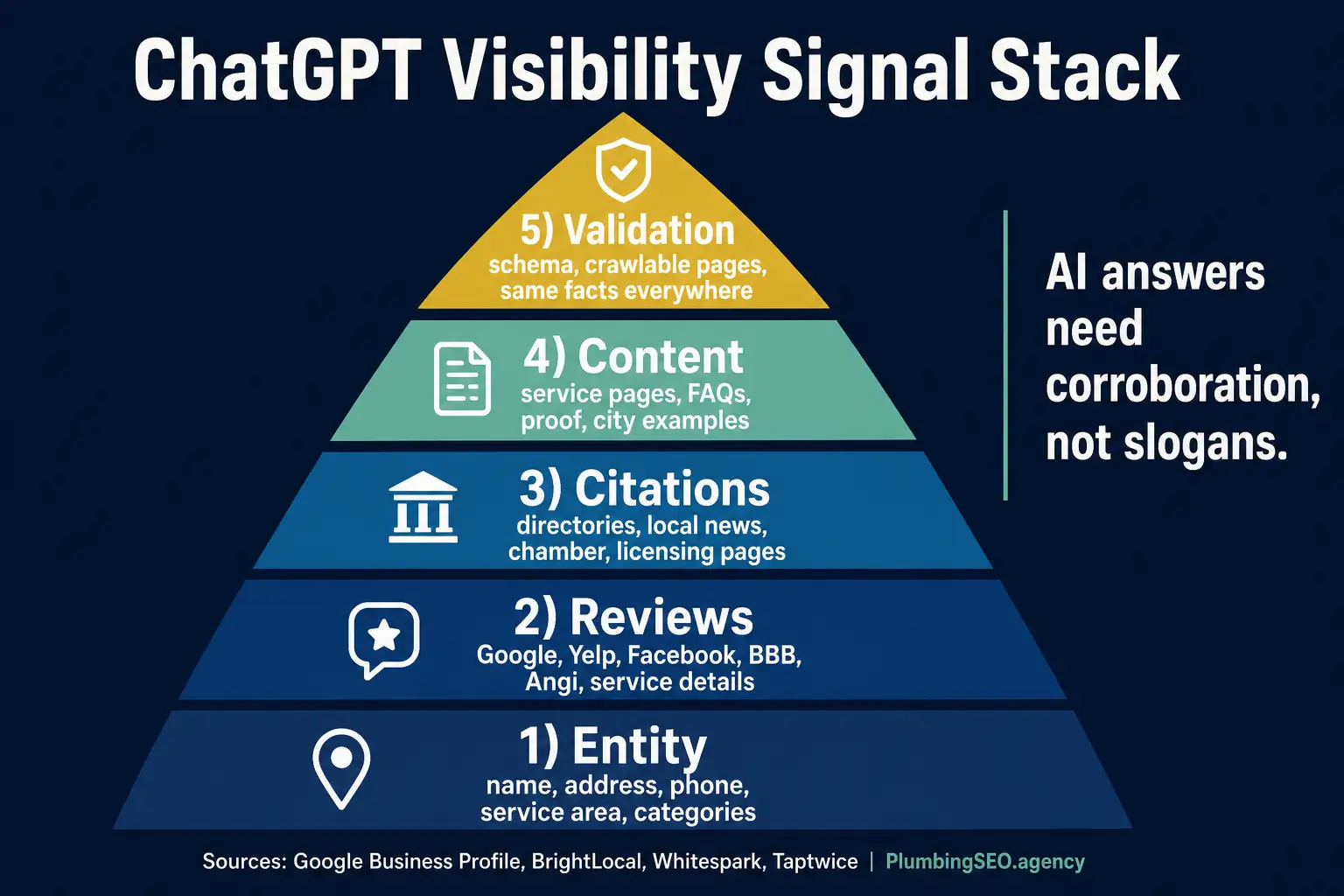
The practical answer is not to write "best plumber" fifty times. That is like tightening the wrong nut and wondering why the leak is still there. ChatGPT visibility for plumbers usually comes from four proof areas: entity clarity, reviews, citations, and content signals.
What ChatGPT visibility means for a plumbing company
ChatGPT visibility means your business can be found, understood, and considered when an AI answer engine builds a response about local plumbing services. That could be a direct recommendation, a cited source, a comparison answer, or a local list that includes your name.
There is no guaranteed "rank number" across every AI tool. Local answers can change based on the user prompt, location, browsing state, data source, and timing. The goal is simpler: make your plumbing company easy to verify from multiple public sources.
That is why this work overlaps with strong plumbing SEO services. A clean Google Business Profile, accurate citations, useful service pages, real reviews, and schema markup all help search engines understand you. They also help AI systems summarize you without guessing.
The entity is the first pipe in the wall
Your entity is the machine-readable version of your business. It answers basic questions. Who are you? Where are you? What do you do? Which towns do you serve? Are you open for emergencies? Are you licensed? Which phone number should a customer call?
Advice Local explains entity signals as structured facts that help Google, Bing, and AI connect a business to a real-world place, category, and service. For plumbers, that means your business cannot look like one thing on your website, another thing on Yelp, and a third thing on a half-finished directory profile.
Start with these entity facts:
- Legal business name and common public brand name.
- Primary phone number used everywhere.
- Address or service-area setup that matches your real operation.
- Core categories such as plumber, plumbing contractor, drain cleaning service, water heater repair, or emergency plumber.
- Service areas listed in a way a customer would actually search.
- Hours, emergency availability, licenses, insurance, financing, and proof points.
Do not make AI tools work like a helper searching the truck for a missing fitting. Put the facts where they can be found.
Reviews are not just stars. They are service evidence.
A five-star rating helps, but the words inside the review are where a lot of the useful context lives. "Great service" is nice. "They replaced our leaking water heater in Plano the same day and explained the warranty" tells a search system what you do, where you do it, and why a customer trusted you.
Google says businesses should respond to reviews, keep profiles complete, and understand that local results are based mainly on relevance, distance, and prominence. Its own Business Profile guidance also notes that positive reviews and helpful replies can help a business stand out.
For ChatGPT visibility, review diversity matters too. Whitespark research found that review sources connected with Bing Places included Facebook, Yelp, TripAdvisor, Porch, Yellowpages, and Angi, with Facebook and Yelp especially visible in the dataset. You do not need every platform on earth. You do need the important ones for your market filled out, accurate, and active.
How to ask for reviews without sounding robotic
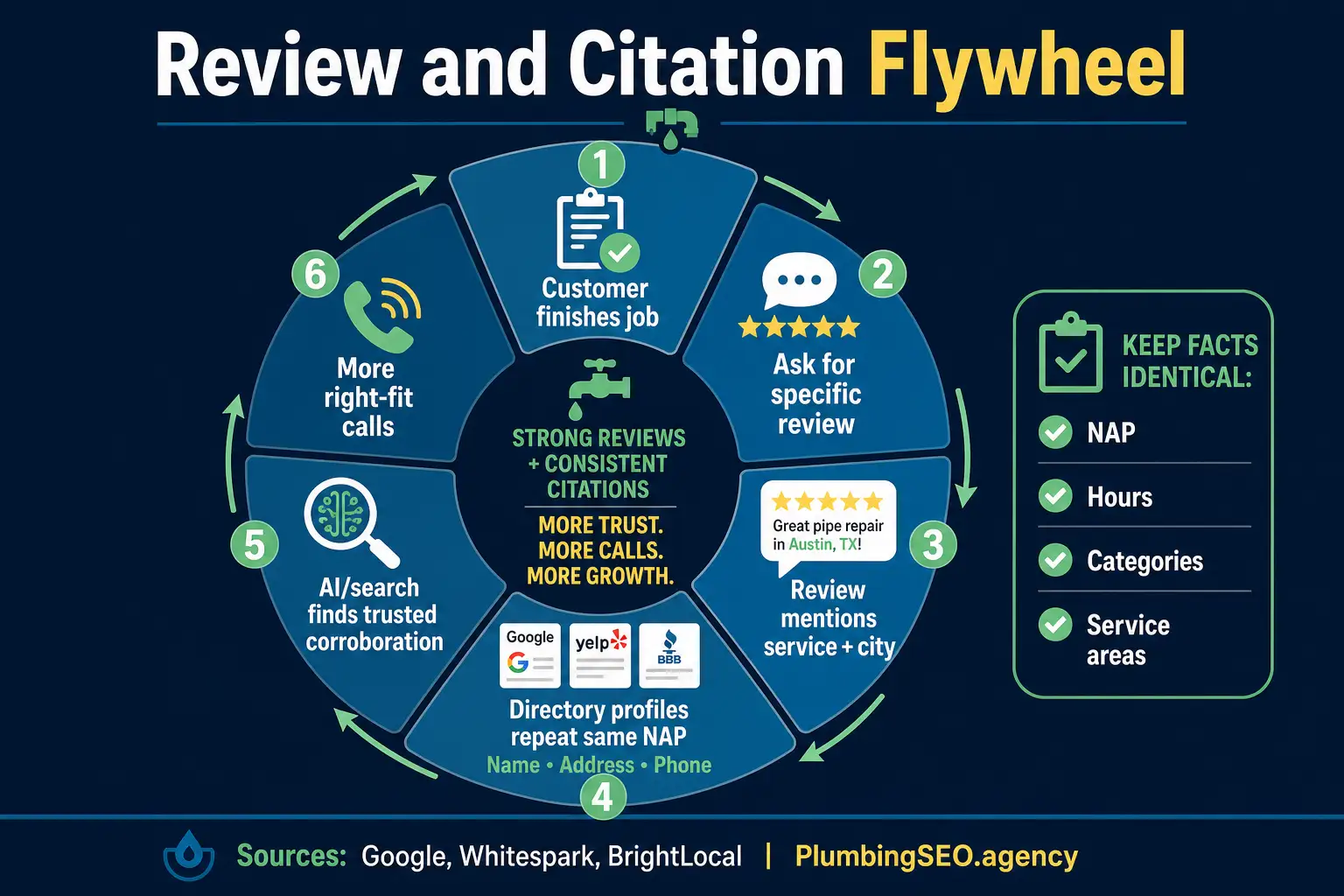
Ask after the job is complete, while the customer still remembers what happened. Keep it plain:
Would you mind mentioning what we fixed and the area you are in? That helps other homeowners know we handle this kind of plumbing problem.
That small prompt can turn a vague review into a useful signal. You are not asking customers to stuff keywords. You are asking them to describe the real work. Burst pipe. Sewer backup. Tankless water heater. Slab leak. Emergency call. Same-day repair. Those details matter because they match the questions people ask.
Citations are back because AI needs corroboration
A citation is a public mention of your business name, address, phone number, website, or profile. For plumbers, the usual places include Google Business Profile, Bing Places, Apple Maps, Yelp, Facebook, BBB, Angi, HomeAdvisor, local chamber pages, licensing pages, and local news or sponsorship pages.
BrightLocal describes local citations as NAP mentions that still help local SEO and AI/LLM information sourcing. Their citation guide also reports that business directories make up 37% of organic results for informational local-intent terms. That matters because AI answers often lean on pages that already show up for local searches.
The plumbing version is simple. If five trusted places agree that you are a licensed plumber serving Fort Worth, with the same phone number and service list, the machine has less reason to doubt you. If half your profiles show an old address, old hours, or a disconnected number, it has every reason to move on.
| Signal | What to check | Why it helps AI visibility |
|---|---|---|
| Entity | Name, phone, address or service area, categories, hours | Helps the system identify the same plumbing company across the web. |
| Reviews | Volume, recency, replies, service details, city mentions | Turns customer experience into searchable proof of real work. |
| Citations | Bing Places, Yelp, BBB, Angi, Facebook, local chamber, licensing pages | Corroborates that the business exists, serves the area, and is trusted outside its own site. |
| Content | Service pages, FAQ answers, job proof, internal links, schema | Gives AI tools clear language to quote, summarize, and connect to customer problems. |
Content signals tell AI what jobs you should be trusted for
Your website should not just say "we do plumbing." It should explain the jobs you want more of and the areas where you can actually send a truck.
That means service pages for water heaters, drain cleaning, sewer repair, leak detection, emergency plumbing, repiping, and any high-value work you want to win. It also means FAQ sections that answer real homeowner questions in plain language. Our guide to AI search optimization for plumbers covers the broader answer-engine strategy. This page narrows it down to the trust signals ChatGPT can verify.
Use content to make the business easy to understand:
- Write one clear page per core service instead of cramming everything into a generic homepage.
- Add city and neighborhood context only where you genuinely serve those areas.
- Show job proof with photos, privacy-safe case examples, and common repair scenarios.
- Answer booking questions such as emergency fees, hours, warranties, financing, permits, and cleanup.
- Use internal links so service pages, trust pages, and relevant blog posts support each other.
If your content does not help a homeowner decide whether to call, it probably does not help an AI answer choose you either.
Schema helps, but it cannot rescue weak facts
Schema markup is structured data added to your page so search systems can understand key facts more easily. Google Search Central says LocalBusiness structured data can describe hours, departments, reviews when applicable, and other business details.
For plumbers, LocalBusiness or PlumbingContractor schema should support what is already visible on the page. It should not invent areas, fake ratings, or mark up reviews that are not actually shown. That is asking for trouble. The markup should confirm the truth, not dress it up for inspection.
What plumbing AI visibility research suggests
A 2026 plumbing-specific AI visibility study from Taptwice Media analyzed 200 AI engine answers across ChatGPT, Perplexity, Google Gemini, and Google AI Mode. The report found 2,060 citation URLs across 645 unique domains. It also reported that licensing verification, customer review volume, and 24/7 emergency availability were the most frequent visibility signals across the engines.
That lines up with what a plumbing customer cares about. Can you legally do the work? Do other customers trust you? Can you handle the problem when the pipe breaks, not three weeks from Tuesday? AI systems are trying to answer those questions too.
A 30-day repair plan for ChatGPT visibility
You do not need a six-month committee to start. You need a clean first pass, then steady upkeep. Here is the practical order I would use if the phones were too quiet and the AI answers kept naming other shops.
Week 1: audit the entity
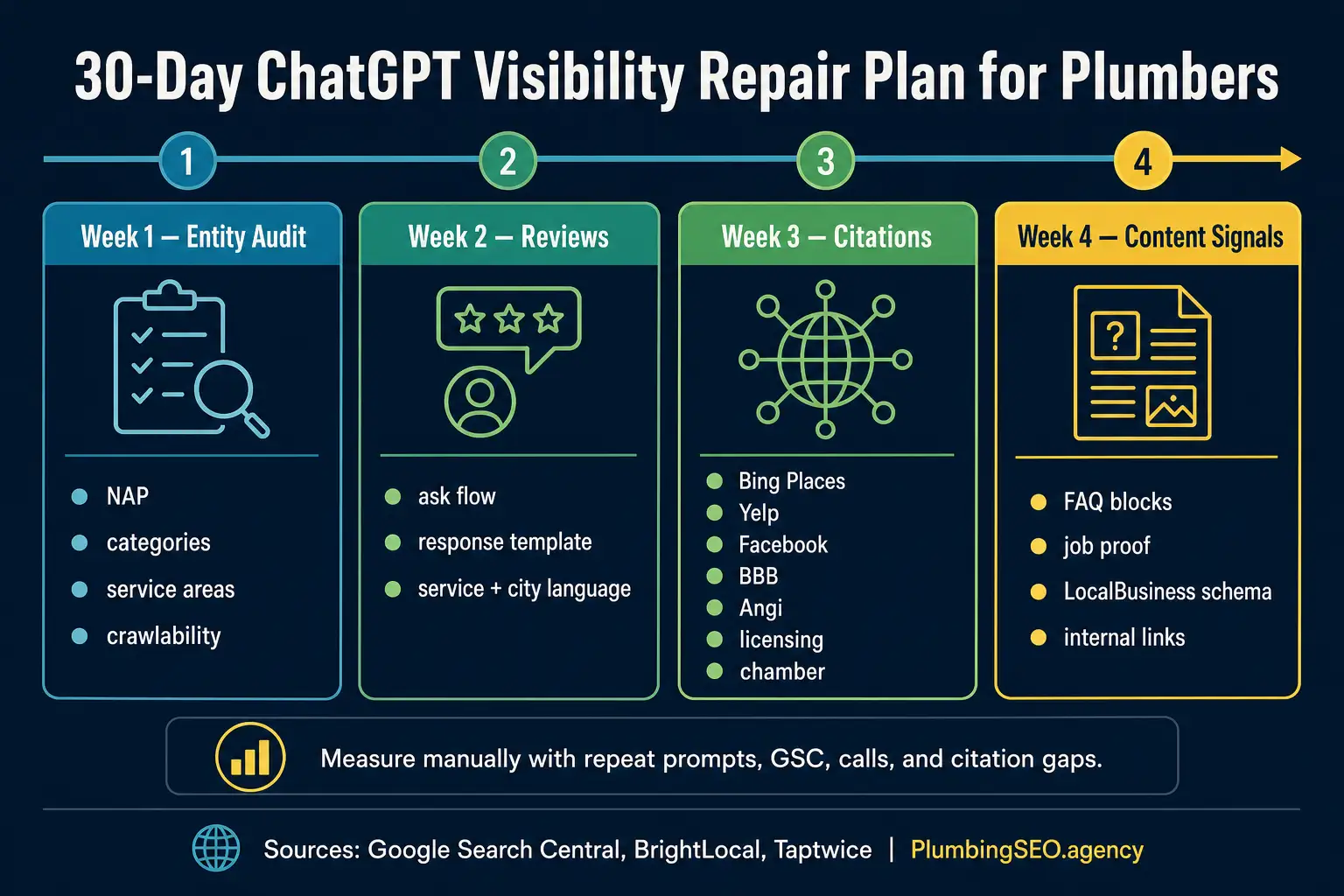
Search your business name, phone number, and address. Check your website, Google Business Profile, Bing Places, Apple Maps, Facebook, Yelp, BBB, Angi, licensing pages, and local directories. Fix mismatched names, old phone numbers, wrong categories, stale hours, and missing service areas.
Week 2: tighten the review system
Create a simple review request that asks customers to mention the service and city if they are comfortable. Respond to reviews like a real owner, not a canned robot. If you repaired a sewer line, say so. If you served a neighborhood, say so naturally.
Week 3: clean citations and third-party profiles
Claim or update the profiles that already rank for local plumbing searches in your market. Prioritize quality over a pile of junk directories. If a profile can show photos, services, hours, emergency availability, and booking details, fill it out.
Week 4: improve content and internal links
Build or strengthen the service pages that matter most. Add clear FAQs. Add proof. Link supporting blog posts to the right money page. If the goal is more booked calls from organic and AI search, your content should support the main plumbing SEO service page and the pages that explain your offer.
How to measure progress without fooling yourself
AI visibility tracking is still messy. Do not judge everything from one ChatGPT prompt on one afternoon. Use a repeatable set of prompts, run them monthly, and record whether your company appears, which competitors appear, and which sources get cited.
Also watch the business numbers. Are more calls coming from organic search? Are more calls mentioning AI, Google, Maps, Yelp, or directories? Are the right services getting booked? A report can look pretty, but the phone tells the truth.
Use these checks:
- Repeat the same AI prompts once a month from the same location context.
- Track Google Search Console queries around your brand, service areas, and AI-search topics.
- Review call tracking notes for mentions of Google, ChatGPT, Yelp, and directories.
- Compare competitor citations and reviews against your own gaps.
- Check whether your service pages are being indexed and internally linked.
The owner-side takeaway
ChatGPT visibility for plumbers is not separate from doing local SEO correctly. It is the next layer of the same job. Make the company easy to identify. Earn specific reviews. Keep citations clean. Publish useful content. Mark up the facts. Then keep doing it.
That is not glamorous, but neither is crawling under a house. The work still has to be done if you want the system to trust what it finds.
FAQ: ChatGPT Visibility for Plumbers
Plumbers improve their chances by making the business easy to verify across the web. That means complete business profiles, consistent NAP, strong reviews, trusted citations, clear service pages, and schema that supports visible page facts.
It depends on the model, browsing mode, and query. Some AI answers may lean on web results, local packs, directories, or cited pages. A complete Google Business Profile still matters because it supports local visibility and confirms key business facts customers and search systems use.
Yes. Citations help confirm that the same plumbing company exists across trusted third-party sources. Accurate profiles on major directories, review platforms, local chambers, licensing pages, and industry sites can strengthen the entity footprint AI tools use to verify a business.
Specific reviews are more useful than vague praise. A review that mentions the service, city, response time, and outcome gives search and AI systems more context than a review that only says "great company." Always ask honestly and never script fake reviews.
Usually no. Start by improving real service pages, FAQs, proof sections, and local content that also helps customers. If a page would not help a homeowner decide to call, it probably is not worth creating only for AI visibility.
The first cleanup can happen in 30 days, but visibility changes usually take longer because profiles, reviews, citations, and indexed content need time to be discovered and trusted. Measure monthly instead of reacting to one prompt result.
Want to know if AI can verify your plumbing company?
We will check your entity footprint, reviews, citations, schema, internal links, and service-page signals so you can see where calls may be leaking.
Run My Free SEO Leak Check